Families weighing kundli matching online vs guna milan performed by a family astrologer are usually asking the same underlying question: does the format change the result. The short answer is that both methods draw from the same underlying system, so the real differences lie elsewhere, in accuracy of birth details and depth of interpretation rather than in the calculation itself.
Ashtakoot Guna Milan: The System Behind the Score
Ashtakoot guna milan is the specific matching system most people mean when they talk about kundli matching in North Indian tradition. Ashta means eight and koota means category, referring to eight separate compatibility factors compared between two birth charts, primarily based on each person's Moon nakshatra. According to Britannica's entry on Jyotisha, the broader Hindu astrological tradition this system sits within, planetary and lunar positions form the basis for nearly all Vedic astrological calculations, which is exactly what ashtakoot guna milan draws from. Vaidik Talk's guide on what is Vedic astrology covers this foundation in more detail for readers newer to how any of this gets calculated.
The Eight Kootas at a Glance
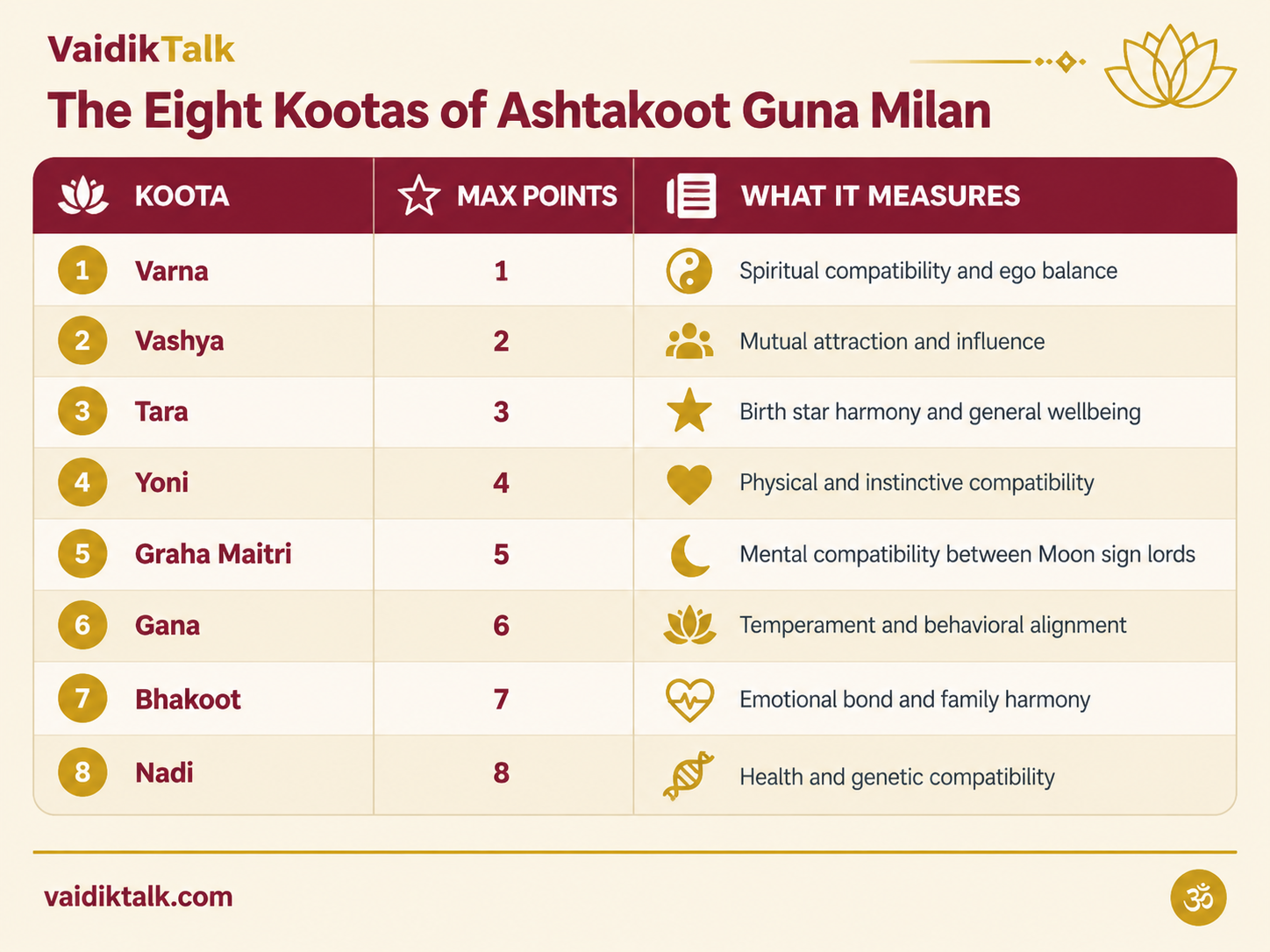
Two of these eight kootas carry more weight than their point values alone suggest. Nadi and Bhakoot are treated as the most consequential, since a zero score in either is generally read as a serious concern regardless of how high the total score runs elsewhere. Traditional texts also describe specific cancellation conditions for these doshas, which is why a low score in one koota doesn't automatically rule out a match without further review.
How Traditional Guna Milan Was Done
Before software existed to automate any of this, guna milan was performed by hand, typically by a family astrologer or priest working from printed panchang tables and each person's birth details. The astrologer would manually calculate each person's Moon nakshatra, look up the corresponding koota values in reference tables, and total the score by hand. This process could take considerable time and depended heavily on the individual astrologer's training and attention to detail, which introduced a real chance of calculation error even when the underlying method was sound.
Online Kundli Matching Accuracy: What Changes and What Doesn't
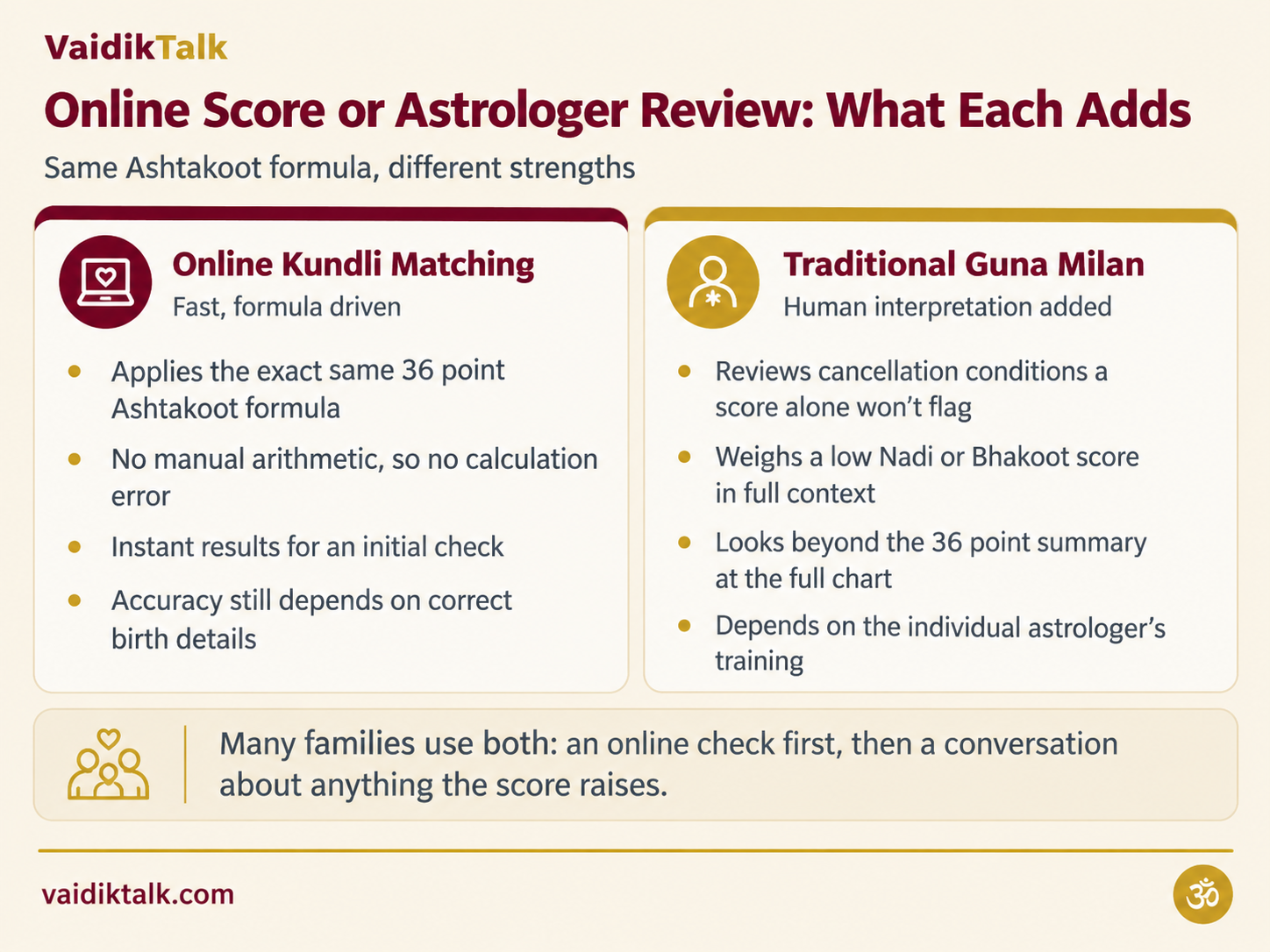
Online kundli matching accuracy comes down to a simpler question than most people expect. The Ashtakoot formula itself is fixed and well documented, so a correctly built calculator applies the exact same rules a traditional astrologer would, without the risk of manual arithmetic error. What online kundli matching accuracy actually depends on is the birth details entered. An incorrect birth time can shift a Moon nakshatra enough to change several koota scores at once, which affects an online tool exactly as much as it would affect a manual calculation. The genuine difference between the two formats isn't the math, it's the interpretation layer that follows the score, understanding why a specific koota scored low, whether a cancellation condition applies, and how the couple's full charts look beyond the 36-point summary. Readers weighing gemstone remedies tied to a weak planet identified during a matching review may find Vaidik Talk's guide on best gemstone for career growth useful for that context.
Kundli Matching Online vs Traditional Guna Milan: Which Should Someone Trust
Framed directly, kundli matching online vs guna milan performed traditionally isn't really a contest between accurate and inaccurate methods. Both rely on the same eight koota system and produce the same score given identical, correctly entered birth details. An online tool offers speed and immediate results, useful for an initial check before deciding whether to pursue a match further. A traditional consultation adds a layer of human judgment that matters most in borderline cases, particularly a low Nadi or Bhakoot score that might have a recognized cancellation condition a formula alone won't flag. Many families use both in sequence, an online check first, followed by a conversation with an astrologer about anything the score raises. Anyone comparing documented facts against marketing claims in a different context may find Vaidik Talk's guide on pyrite vs citrine a useful parallel read on the same kind of evidence based approach.
Getting Started
Readers preparing to check compatibility can use Vaidik Talk's Kundli Matching report, which applies the ashtakoot guna milan system alongside a review of Manglik and other dosha factors rather than a flat score alone. For couples where one partner's chart shows a Manglik indication specifically, the guide on what is Manglik Dosh is worth reading before assuming it rules out a match. Readers focused on remedy objects related to a chart finding may also find best pyrite bracelet for money and prosperity relevant as well.
Getting the Right Guidance
A guna milan score is a starting point for a conversation, not a final verdict on its own, whether it's calculated online or by hand. Anyone with questions about their own matching results can reach out through the Contact Us page, and the team will point them to the right report or consultation.
Frequently Asked Questions
Does an online kundli matching tool give a different score than a traditional astrologer?
Not if both use the same accurate birth details, since the underlying Ashtakoot formula is standardized and produces the same result either way.
Which koota matters most in guna milan?
Nadi and Bhakoot carry the highest point values and are generally treated as the most consequential, since issues here can outweigh a high total score elsewhere.
What score is considered a good match in ashtakoot guna milan?
Eighteen out of thirty six points is the commonly cited minimum threshold, though the specific koota scores matter as much as the total.
Can a low guna milan score be overridden?
Traditional texts describe specific cancellation conditions for certain doshas, which is why a low score in one area is usually reviewed rather than treated as an automatic rejection.
Is online kundli matching reliable for a final decision?
It's reliable for the calculation itself, but most families still consult an astrologer for interpretation, especially when a specific koota score raises a concern.