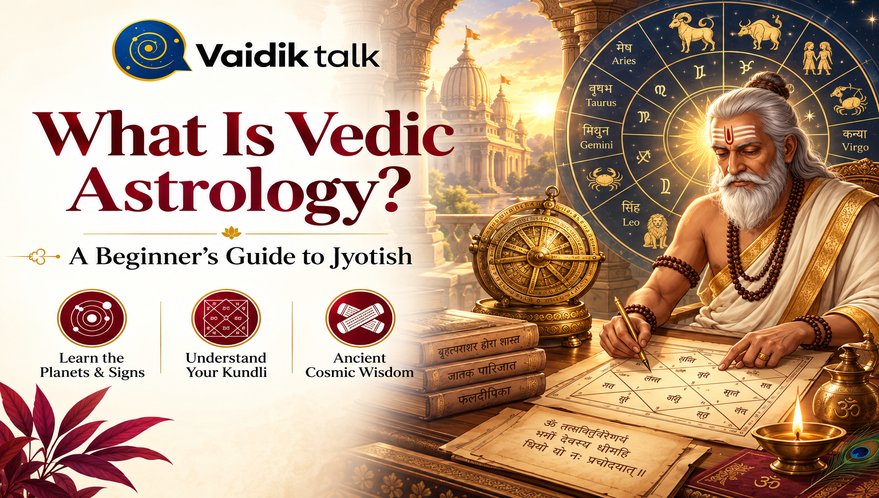
If you ever stumbled upon the question, what is Vedic astrology, let me tell you, you're asking a fair question. Vedic astrology is also called Jyotish. It is basically a system that reads the position of the planets at the exact moment someone was born and utilizes that information to construct and structure their personality, relationships, and the general timing of events in their life. In this blog, we are going to discuss the entire jyotish meaning along with the core terms and will cover the Vedic astrology basics. This is important to know before you attend your first reading. Doing so, you will have enough knowledge to comprehend the statements of an astrologer while describing the charts.
What Is Vedic Astrology, Really?
Vedic astrology is a separate and exhaustive branch of Jyotisha. This, via a Sanskrit term, apparently means the science of light or the science of the heavenly bodies. That's the mini explanation of the jyotish meaning most people ask about. Here, light refers to planets and stars, and their positions give information that you can read just like you can read a map. Once you understand the jyotish meaning in its simplest form, we can assure you that the rest of the terminology gets a lot less intimidating.
Let’s be honest, this is very different from a newspaper horoscope column. In Vedic astrology, a full-fledged Vedic chart called a kundli or janam kundli is created for every individual based on their exact date, time, and place of birth. We don’t want to spoon-feed, but you can already imagine that time and place accuracy plays a pivotal role, as two people born an hour apart in the same hospital can end up with noticeably different charts.
In contrast to Indian astrology, Western astrology tracks the sun's position against a fixed calendar zodiac (called "tropical"), but when it comes to Vedic astrology, it works on the actual, visible position of the stars (called "sidereal"). To share an interesting fact, over the centuries both have drifted by around 24 degrees. For the same reason, a person’s Western sun sign and Vedic moon sign often don't line up the way they expect.
The Vedic Astrology Basics
Before reading specifics, an astrologer works with four building blocks based on which every kundli, remedy, and prediction is created -
Graha (Planets) - 9 grahas, and yes these include the famous Rahu and Ketu. There are lunar nodes considered as full planetary influences in Vedic astrology although they are mathematical points rather than physical bodies.
Rashi (Zodiac Signs) - The 12 well-known signs, used here in their sidereal positions.
Bhava (Houses) 12 houses - each representing an area of life. For instance, 1st house represents self and body, 7th reflects on partnerships and likewise 10th is for career.
Nakshatra (Lunar Mansions) - 27 subdivisions of the zodiac based on stars and used for finer timing, name selection, and compatibility.
If you have the knowledge of these 4 elements you automatically have the Vedic astrology basics with you.
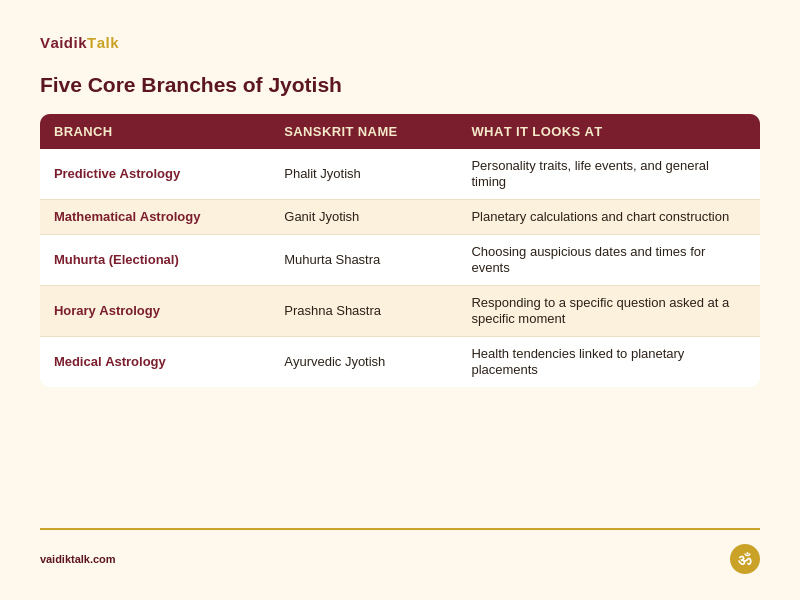
Five Core Branches of Jyotish
Vedic astrology is divided into distinct branches -
How Vedic Astrology Works, Step by Step
There are three inputs that describe how vedic astrology works in practice: your birth date, your birth time down to the minute and seconds possible, and your last input is your birth place. A well-trained astrologer, or a chart-generation tool, will use these 3 inputs to devise exactly where each graha sat in the sky at that moment, then mark those positions across all the 12 houses of your kundli.
Then, you usually read 3 pieces of information together. First, your Lagna (your rising sign on the eastern horizon at the time of your birth). Second is your Moon sign and the placement of Rahu and Ketu. Add Dasha, extended periods ruled by a particular planet, some of them years long, and lastly you have the timing layer that’s part of the reason Vedic astrology tends toward prediction more than many other systems do. Once you understand how Vedic astrology works in this way, a kundli no longer looks like a wall of symbols, but more like a personalized timeline.
Why So Many People Still Turn to It
Once you understand what Vedic astrology is on paper, the bigger question is why it has stayed this relevant. Pew Research Center's large-scale study on religion in India found that 44% of Indians said they believe the position of planets and stars can influence events in their lives, and separately, 83% said they schedule important dates around auspicious timing, regardless of whether they'd call themselves believers. That gap between stated belief and actual practice says a lot: Jyotish functions as a planning tool for many people, more than a belief system.
According to market research by MarkNtel Advisors, the astrology app market in India is valued at $163 million in 2024, and is projected to reach around $1.8 billion by 2030. This shows an annual compound growth rate of approximately 49%. This is because people often look for a quick, low-pressure first read before making any commitments.
Vedic astrology is typically consulted for matching horoscopes for marriage, ensuring favorable time for a new job or business, and when buying a new property. None of these need a deep background in Sanskrit terms. Needless to say, many people go to astrologers with a specific question. They get their kundli built once, and then refer to it again whenever a new decision comes up.
One practical tip that we will give you before your first session: have your birth certificate, hospital record, or a family member's memory of the exact time on hand. Astrologers would not like vague answers like morning or around noon, maybe night. Of course, a rough time is enough for a general reading, but if you want precise or best answers, go in with accurate knowledge.
It also helps to know that younger users aren't treating this as an either-or choice between tradition and technology. A lot of people run a free chart online first, sit with the results for a few days, then book a paid consultation only for the specific questions the free version couldn't fully answer.
Getting Your Own Chart Read
You don't need to memorize all 27 nakshatras before your first conversation with an astrologer. The Vedic astrology basics covered here grahas, rashis, bhavas, nakshatras give you enough to follow along rather than just nod. If you want to see how one remedy-based system built on this same foundation works in practice, our post on why Lal Kitab is popular in Vedic astrology is a good next stop. It swaps gemstones and elaborate rituals for household objects and simple remedies.
If you'd like to try a first reading yourself, Vaidik Talk's AI Astrologer builds a reading from your birth details in minutes, at no cost. If you have something particular to ask such as queries around marriage, job change, or financial decision, you can talk to an Astrologer directly and ask about your own chart rather than a generic one.
Ready to See Your Own Chart?
Vedic astrology rewards a bit of patience; its value tends to show up across a few readings rather than one lucky guess. If you have questions about your own kundli or want a real person to talk you through it, reach out through our Contact Us page, and our team will point you to the right report or consultation for what you're dealing with.
Frequently Asked Questions (FAQs)
Do I need my exact birth time for an accurate reading?
Yes, you must have precise knowledge of your birth time, place, and date. A difference of even a few minutes can entirely change your ascendant and house placements.
What exactly is a kundli?
A kundli is a well-organized Vedic birth chart. It can be created manually by someone who has knowledge of astrology or via software as well. It requires our exact birth date, time, and place.
Can Vedic astrology predict exact dates for events?
No, it can never determine the precise date or time for any event. However, it only projects the favorable and difficult periods through Dashas, based on which you can plan things.
Is Jyotish tied to a specific religion?
Not really; it goes deep inside the understanding of Vedic tradition, but a lot of people use it as a practical planning tool irrespective of their religion.