Ask any astrologer in India about remedies, and the conversation drifts toward Lal Kitab pretty fast.
It's become such a common reference point. Most people who've heard the name, though, can't really explain what sets it apart from the Vedic astrology their parents grew up with. They just know it "works fast" and doesn't ask for a fortune in rituals along the way.
That reputation didn't come from nowhere. Lal Kitab built its following by doing something classical Jyotish mostly avoids — handing someone a fix they can carry out themselves, that same evening, using stuff already sitting in the kitchen.
What Is Lal Kitab, Really?
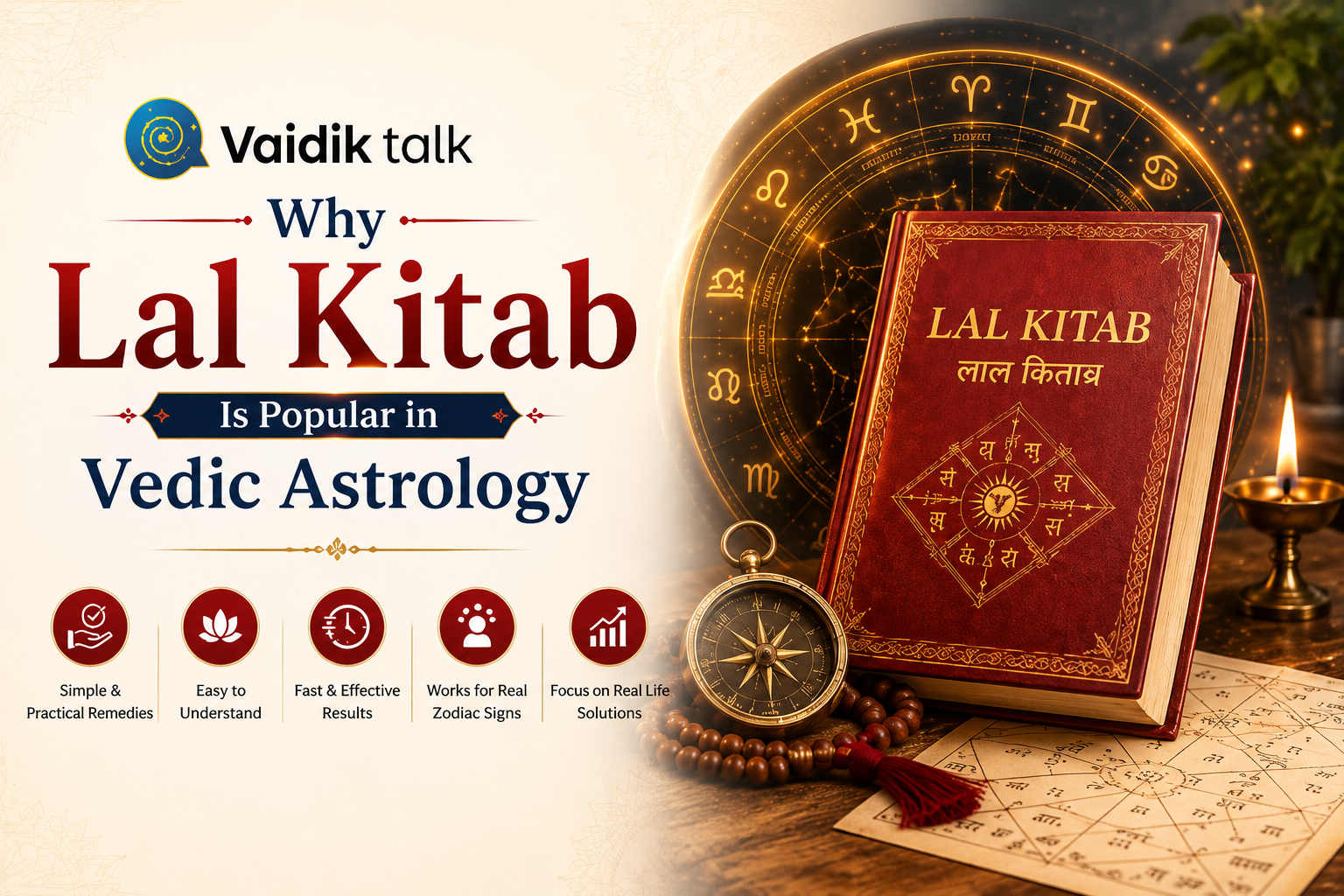
"Red Book," if you translate it directly. A body of texts that showed up sometime in the 19th and early 20th centuries, written in Urdu mixed with Persian-influenced Hindi, not Sanskrit, which already sets it apart. Nobody's fully agreed on who wrote it, and that unresolved authorship only adds to the mystery around it.
What it kept from Vedic astrology is basic — nine planets, twelve houses. What it was built on top of is its own thing:
- Planets owe each other debts in this system.
- They act as friends or enemies depending on where they sit.
- Sometimes your current mess traces back not to your own birth chart alone, but to something an ancestor left unresolved.
That's really the fork in the road. Classical Vedic astrology chases precision — exact degrees, nakshatras, dasha timelines mapped out to the day. Lal Kitab isn't chasing that kind of exactness. It wants a working diagnosis and a next step.
What Is Lal Kitab and How Is It Different from Traditional Vedic Astrology?
If you've sat through a Vedic reading before, you know the shape of it — a dense birth chart, planetary periods stretching years out, maybe a gemstone recommendation you'll be wearing for the rest of your life. Thorough. Also, a lot to commit to.
Lal Kitab cuts a lot of that away. The quick takeaways:
- Fixed chart. Always the same twelve boxes, unlike the North Indian, South Indian, and East Indian layouts used elsewhere in Jyotish.
- Planetary debt ("Rin"). Most famously, Pitra Rin — ancestral debt — a concept mainstream astrology barely touches.
- Remedies come first, not last. Where classical astrology often leans on mantras and multi-year rituals, Lal Kitab hands you something one-time or short-term: jaggery, a coconut, a handful of coins — done for a fixed number of days, then closed.
- A palmistry layer folded in, absent from standard Jyotish entirely.
Traditional Vedic Astrology vs. Lal Kitab: Key Differences
Worth remembering: Neither system is "more correct." They're built for different jobs — Vedic astrology maps timing in fine detail, while Lal Kitab is built for correction on a short timeline.
Why Are Lal Kitab Remedies So Popular for Solving Life Problems?
A lot of it just comes down to how little they ask of you. No priest required. No weekend cleared for a haven. Feed jaggery to ants on a Wednesday. Skip a certain color for a stretch. That's a low bar, and low-effort remedies get followed through on far more often than the elaborate kind, which matters more than people give it credit for.
There's a psychological piece, too. Being told why something's going sideways, in specific terms — this planet, this house, sometimes even a pattern going back generations — tends to settle people, even before anything's actually changed. A problem with a name feels more manageable than a problem that's just vaguely there.
And then word spreads the way it always does. Someone tries a remedy right before a stalled promotion finally comes through, and the story travels. Whether the remedy caused it is a separate, much harder question — but the impression sticks, and those positive experiences are one reason Lal Kitab has continued to grow in popularity.
⚠️ Keep in mind: These are traditional, faith-based practices. There's no clinical evidence tying a specific remedy to a specific career or health outcome. Most people who take this seriously treat it as one piece of a bigger effort — alongside the actual job search, the actual doctor visits, the actual budgeting — not a stand-in for any of it.
Most Effective Lal Kitab Upay for Career, Marriage, Health, and Financial Growth
There isn't one remedy that fits everyone — that's sort of the whole point of the system, since it's built around which planets are weak or in debt in your chart specifically. But broadly, remedies cluster around a few recurring areas:
- A career usually traces back to the 10th house, along with Saturn and Mercury — discipline and communication. Remedies here often involve donations tied to a specific weekday linked to whichever planet is struggling.
- Marriage delays or friction points toward Venus and the 7th house. When Rahu is involved, the remedy usually shifts toward calming its disruption rather than boosting Venus directly.
- Health falls under the 6th house. Remedies often pair a symbolic act — donating dark-colored items for a troubled Saturn, say — with actual lifestyle changes. Not instead of medical care. Alongside it.
- Money troubles get traced to the 2nd and 11th houses, plus Jupiter, which Lal Kitab treats as the main signifier of wealth and growth.
Fast fact: Lists like this are a starting point, nothing more. What's genuinely useful for you depends on your own chart, which is really the whole case for getting an actual reading instead of copying whatever remedy is going around online this month.
When Should You Choose a Lal Kitab Consultation from a Lal Kitab Expert?
Not every rough patch needs astrology. But a few situations make a consultation worth considering:
- You've already tried the practical stuff — job hunting, therapy, financial advice — and something still feels stuck underneath it all.
- A big decision is coming (marriage, a career switch, buying property), and another lens on it before committing wouldn't hurt.
- The same kind of trouble keeps showing up across generations in your family, which in Lal Kitab terms might point to an ancestral debt nobody's addressed.
- You'd simply rather do something small and concrete than sit through a long ritual you don't fully understand anyway.
⚠️ Red flag: A genuine Lal Kitab expert builds your chart from your birth details rather than reciting the same three remedies to everyone. If a "consultation" jumps straight to selling you a product, that's usually the moment to walk out.
How Lal Kitab Astrology Helps With Everyday Challenges
What's kept Lal Kitab Astrology relevant this long isn't its theory. It's that it's meant to be used. It doesn't just warn you a rough patch is coming — it hands you something to actually do about it.
For someone watching a marriage proposal collapse for the third time, or a business that won't take off no matter how hard they push, or a health issue no doctor has fully explained, having something to act on matters. Sometimes, almost as much as whatever the remedy actually does.
It's not a replacement for effort. It's not a replacement for a doctor, a lawyer, or a financial advisor. But as a companion to the real work — a way to feel less stuck while you're also doing everything else — it's not hard to see why it's lasted.
FAQs
Q1. What is Lal Kitab, and how is it different from traditional Vedic astrology?
A: It's a distinct system built on the basic bones of Vedic astrology — planets, houses — but layered with its own ideas: a fixed chart format, planetary debts, and a palmistry influence classical Jyotish doesn't have. The practical difference comes down to emphasis. Vedic astrology leans toward precise, long-range prediction; Lal Kitab leans toward quick, doable correction.
Q2. Why are Lal Kitab remedies so popular for solving life problems?
A: Mostly because they ask so little. No priest, usually no cost beyond a household item, often just a few minutes of your time. That low barrier means people actually follow through, and when life improves afterward for whatever reason, the remedy gets the credit. The story travels from there.
Q3. What are the most effective Lal Kitab upay for career, marriage, health, and financial growth?
A: It depends entirely on the individual chart, but as a rough map: career issues trace to the 10th house, marriage to the 7th house and Venus, health to the 6th house, and money to the 2nd and 11th houses plus Jupiter. A personalized reading is really the only way to know which of these applies to you specifically.
Q4. When should you choose a Lal Kitab consultation from a Lal Kitab expert?
A: When practical effort alone hasn't moved a persistent problem, before a major life decision, or when a pattern seems to repeat across generations in the family. A real expert works from your actual birth chart — not a script they use on everyone.
Q5. How does Lal Kitab astrology help with everyday challenges?
A: By pairing a diagnosis with an action. Instead of leaving someone to just sit through a rough stretch, it hands them something concrete to do, which, for a lot of people, matters emotionally just as much as whatever the remedy is meant to fix astrologically.
Q6. Are Lal Kitab remedies scientifically proven?
A: No. Like other astrological traditions, it's rooted in belief and cultural practice rather than clinical evidence. Plenty of people find genuine comfort and a sense of agency in it — but it works best sitting alongside real effort and professional advice, not standing in for it.
Q7. Can you perform Lal Kitab remedies without consulting an expert first?
A: You can, and a lot of people do — pulling remedies from the internet or family tradition. Those tend to be generic, though. A consultation matches the remedy to your specific chart — the difference between something that might help and something built for your actual situation.