
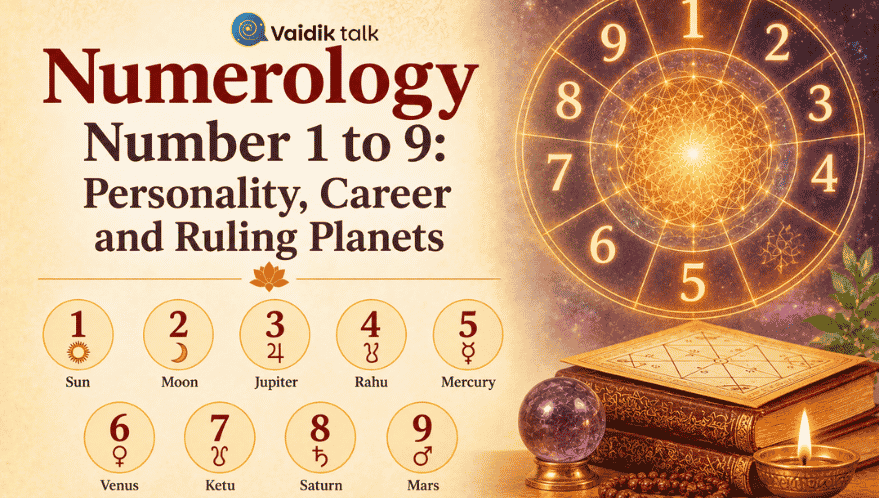
Numerology numbers 1 to 9 form the foundation of many number-based spiritual traditions. Each number is associated with personality themes, behavioural tendencies and symbolic planetary influences. These interpretations are commonly used for self-reflection, relationship discussions and exploring personal interests.
However, numerology does not establish intelligence, employability or future success. Britannica’s overview of number symbolism places numerical meanings within cultural, religious and philosophical traditions rather than scientific personality assessment.
Understanding numerology number meanings begins with identifying the calculation being used. A birth number, life path number and name number describe different things within the system.
VaidikTalk’s beginner guide to numerology provides useful background before examining individual numbers.
Understanding Numbers and Planets
Birth Number, Life Path and Name Number
A birth number, often called Mulank in Indian numerology, is derived from the calendar day of birth. The digits are reduced to a single number.
The life path number generally uses the complete birth date. Calculation conventions vary, particularly where schools retain master numbers such as 11, 22 or 33.
A name number assigns numerical values to letters. Different letter-value systems can produce different results for the same name.
These labels should remain separate. Someone may have one birth number and a different life path number without any contradiction. The life path number guide explains that distinction further.
Numerology Ruling Planets
The following numerology ruling planets reflect a common Indian mapping; other systems may use different associations.
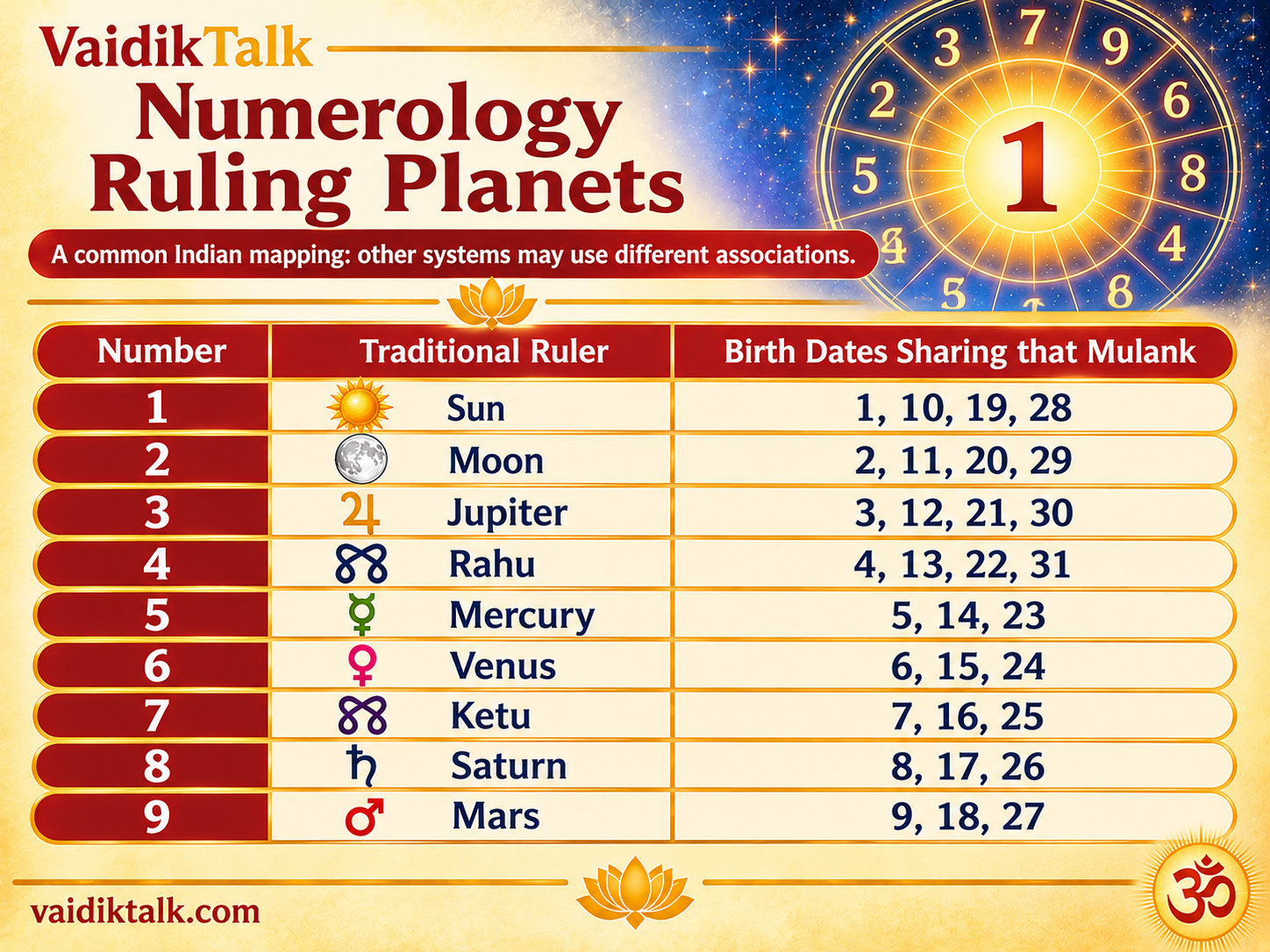
The birth-date groupings and planetary assignments above follow the same commonly used Indian framework.
Here, “planet” is a traditional astrological category. Britannica’s Navagraha reference explains that the nine grahas include the Sun, Moon and the shadow planets Rahu and Ketu.
Readers can compare this symbolic framework with the foundations of Vedic astrology.
Personality and Career Themes
The profiles below describe popular interpretations, not measured personality findings. Career examples are prompts for exploration, not recommendations based on birth dates.
Number 1: Initiative and Independence
Traditional ruler: Sun
Number 1 is commonly associated with initiative, ambition and independent thinking. Its positive themes include taking responsibility, setting direction and beginning projects.
Potential difficulties include impatience, excessive competitiveness and reluctance to accept feedback.
Career discussions often mention entrepreneurship, management, administration and project leadership. These options still require relevant competence. Someone drawn to leadership benefits from practising delegation and listening rather than assuming leadership ability from a number.
Number 2: Cooperation and Sensitivity
Traditional ruler: Moon
Number 2 is associated with diplomacy, cooperation and emotional awareness. Popular descriptions present it as attentive to relationships and comfortable supporting shared goals.
Possible challenges include indecision, sensitivity to criticism and difficulty setting boundaries.
Career themes include customer support, human resources, coordination, mediation and collaborative creative work. A person considering counselling or healthcare must meet professional education and licensing requirements; perceived sensitivity alone is insufficient.
Number 3: Expression and Learning
Traditional ruler: Jupiter
Number 3 is linked with communication, enthusiasm, learning and sharing ideas. Traditional profiles often describe an interest in explaining concepts or encouraging others.
Its development themes include following through, accepting correction and balancing confidence with preparation.
Teaching, training, writing, public communication and advisory work are common career associations. Actual suitability depends on subject knowledge, communication skills and the ability to work responsibly with others.
Number 4: Structure and Independent Thinking
Traditional ruler: Rahu
Number 4 is often associated with unconventional thinking, practical effort and questioning established methods. Interpretations vary noticeably across numerology schools.
Possible challenges include rigidity, resistance to guidance and frustration with slow progress.
Career themes may include technology, operations, systems work, process improvement and research support. These are broad possibilities rather than exclusive matches. Training, experience and enjoyment of the actual tasks provide stronger guidance.

Number 5: Adaptability and Communication
Traditional ruler: Mercury
Number 5 is commonly connected with curiosity, adaptability, communication and a preference for variety.
Its challenges may include impulsive decisions, inconsistent effort and difficulty completing repetitive work.
Sales, journalism, marketing, languages, business development and travel-related services frequently appear in traditional career lists. A person attracted to variety can test that preference through short projects while developing reliable routines and financial discipline.
Number 6: Care and Aesthetics
Traditional ruler: Venus
Number 6 is associated with relationships, responsibility, beauty and creating comfortable environments.
Popular interpretations also mention overcommitment, people-pleasing and spending too much on appearances.
Career themes include design, hospitality, teaching, arts administration and customer experience. A reflective question concerns whether someone enjoys the daily responsibilities of these fields, not simply their appealing image.
Number 7: Inquiry and Reflection
Traditional ruler: Ketu
Number 7 is traditionally connected with contemplation, investigation, spiritual curiosity and independent study.
Possible challenges include withdrawal, excessive doubt and difficulty communicating conclusions clearly.
Research, analysis, writing, software testing and academic study are common associations. These roles demand different qualifications. Someone interested in analytical work benefits from assessing problem-solving skills and tolerance for sustained investigation.
Number 8: Discipline and Organisation
Traditional ruler: Saturn
Number 8 is commonly associated with persistence, responsibility, organisation and long-term effort.
Potential difficulties include overwork, pessimism and placing too much importance on status or measurable achievement.
Administration, accounting, logistics, compliance and operations management often appear among career themes. Number 8 should not be treated as an unlucky label or a prediction of hardship. Practical progress depends on preparation, opportunity and circumstances.
Number 9: Courage and Service
Traditional ruler: Mars
Number 9 is associated with courage, directness, generosity and energetic action.
Its development themes include managing anger, avoiding impulsive commitments and directing enthusiasm toward achievable goals.
Traditional career discussions may mention emergency services, engineering, sport, public service and field operations. These professions involve specific physical, technical or educational standards that a numerology profile cannot establish.
Applying the Meanings Responsibly
Career Exploration Beyond Numbers
A constructive reading of numerology numbers 1 to 9 asks whether a description matches lived experience. It should not exclude a profession or discourage someone from gaining a skill.
Practical exploration includes comparing interests, qualifications, work environments and training costs. My Next Move’s career-interest framework groups work preferences into six areas, including investigative, artistic, social and enterprising interests.
For further research, the US Bureau of Labor Statistics Occupational Outlook Handbook provides occupation information; its education and employment context is U.S.-specific.
Numerology number meanings can serve as reflective prompts, but they should not determine hiring, promotion or financial commitments.

Relationships and Other Astrological Concepts
A single number cannot establish relationship compatibility. Trust, safety, communication and shared expectations deserve greater attention than a favourable numerical pairing.
Readers interested in traditional chart-based practices can review Kundli matching and Guna Milan and Manglik Dosh interpretations.
Likewise, numerology ruling planets do not establish astrological yoga or dosha. Those researching separate concepts can explore:
Traditional Sade Sati interpretations, Kaal Sarp Dosh, and the distinction between them also concern separate frameworks.
Spiritual Products and Personal Choice
Numerology does not make a bracelet, gemstone or ritual purchase compulsory.
For devotional interests, readers can explore Rudraksha’s spiritual significance, traditional and buyer-reported benefits, and certification considerations.
VaidikTalk Store lists a 5 Mukhi Rudraksha bracelet as a devotional accessory. Such purchases should not be presented as mechanisms for obtaining employment or changing a birth number.
Related reading includes emerald versus peridot and traditional Vastu practices for prosperity. Neither replaces practical budgeting.
Conclusion: Reflection Without Fixed Labels
The value of exploring numerology numbers 1 to 9 lies in thoughtful reflection rather than fixed judgments. Personality is more complex than nine categories, and career development requires learning, practice and access to opportunities.
Readers can compare Nadi and Vedic astrology or review Kundli report options to understand different services.
For a discussion of numerology number meanings and numerology ruling planets, readers can contact Vaidik Talk and ask about the method, scope and limitations of a consultation.
Frequently Asked Questions
What do numerology numbers 1 to 9 represent?
They represent traditional symbolic personality themes rather than scientifically established personality categories.
Are birth numbers and life path numbers identical?
No, the birth number uses the birth day, while the life path generally uses the complete birth date.
Do all numerology systems use the same planets?
No, planetary assignments and calculation conventions vary between traditions.
Can numerology select a suitable career?
It can provide reflective prompts, but interests, skills, qualifications and opportunities should guide career decisions.
Which distinction matters most when reading a report?
The report should clarify whether it interprets a birth number, life path number or name number.