A search for the benefits of rudraksha tends to yield two fundamentally different kinds of claims that are conflated: an ancient spiritual tradition and contemporary wellness marketing, often in the same source. This article breaks down the difference, discussing rudraksha spiritual benefits as they actually appear in the tradition, and examining what has actually been proven about rudraksha health benefits, as opposed to what is claimed
Rudraksha Spiritual Benefits: What Tradition Describes
Rudraksha spiritual benefits are the more consistent part of the reputation of the bead, derived from centuries of Hindu and Buddhist practice rather than contemporary marketing practices. As detailed further in what is Vedic astrology, Rudraksha fits into a wider tradition of objects connected to meditation and spiritual focus, and its most prominent traditional use is a mala of 108 beads for counting mantra repetitions. Rudraksha practitioners speak of it as an aid to concentration during meditation, an anchor during stressful times, and a physical presence during an ordinary day. These rudraksha spiritual benefits are inherently subjective, attached to any personal practice on a personal level, which separates it fundamentally from the more specific and contested health claims that accompany it.
Rudraksha Health Benefits: What's Actually Been Studied
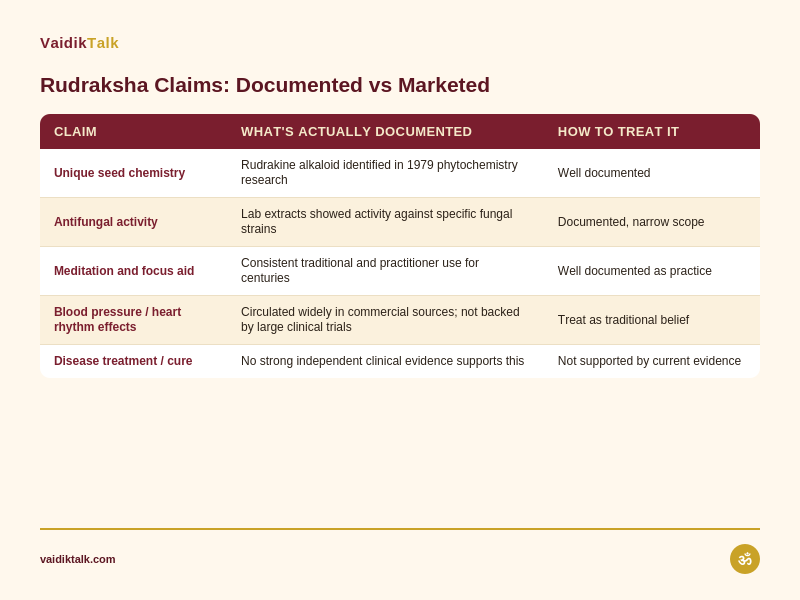
When it comes to rudraksha health benefits, there is the most reason to be cautious, as plenty of commercial sources seek to capitalize on preliminary, inconclusive evidence. The actual list of scientifically documented rudraksha health benefits is rather small and does not include any substantial medical claims, despite what some vendors and marketers may try to make you believe. The only pharmacologically relevant substance found in rudraksha beads is an alkaloid, which was first isolated and identified in the seeds back in 1979. A study published in the “Journal of Natural Products” and listed on PubMed Central concluded the presence of the alkaloid in the rudraksha seeds, thus warranting further research into the potential pharmacological applications of the substance. A pharmacognostic study also appeared in the database, which tested the extract of rudraksha seeds for its antifungal properties in vitro and found it to be effective against several fungal strains.
Apart from that, there are reports, which again come mostly from commercial outlets, of the beads’ ability to lower blood pressure, balance the heartbeat, and alleviate conditions such as hypertension, anxiety, depression, and chronic illness, among other purported rudraksha health benefits. Some of the claims go as far as including the beads’ alleged paramagnetic and electromagnetic properties in the purported healing mechanisms. However, they are not supported by any large-scale independent clinical trials, which is why they are better regarded as fringe facts. When it comes to actually treating a medical condition, especially something serious like high blood pressure, rudraksha beads should only be used as a complement to an established treatment regimen and never as a replacement for proven medication in conjunction with the advice from medical professionals.
Claims at a Glance: What's Documented vs What's Marketed
Benefits of Rudraksha in Daily Practice
Away from contested health claims, the benefits that Rudraksha typically exhibit most are relatively minor and universal: it serves as a tactile aid for counting mantras, a wearable reminder of spiritual intention, and a piece of culture and personal value that is passed on for generations. These everyday benefits tend to outweigh particular physiological benefits that Rudraksha may provide for its wearers, as it serves not only as a tool for practice but a part of a spiritual tradition. This overlaps with the reason these objects are often grouped together in casual conversation with other remedy objects, such as what is outlined in best gemstones for career growth, even as they exist in different cultural traditions.
What the Research Doesn't Establish
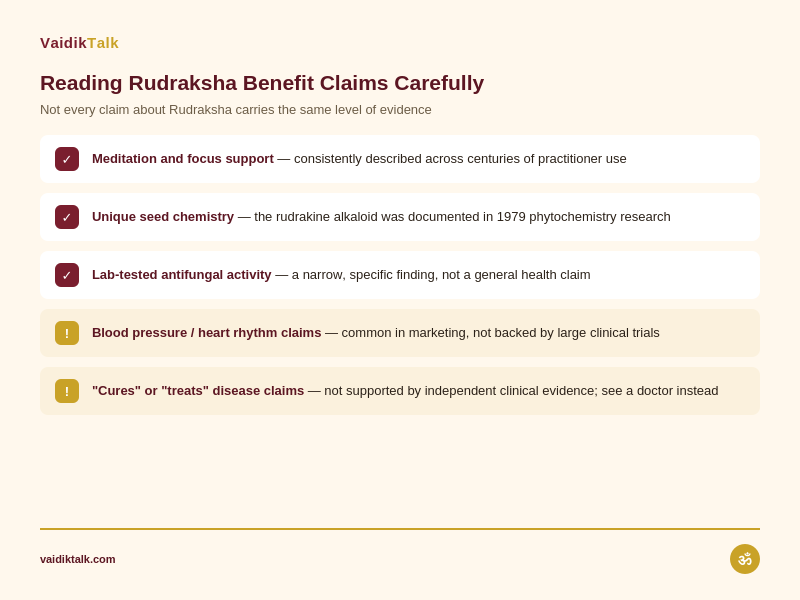
It's worth being direct about the limits here: claims that Rudraksha cures or treats specific diseases go well beyond what any of the currently available research actually shows. The genuinely documented findings, the seed's unique alkaloid and its lab-tested antifungal activity, are real but narrow. Broader claims about disease treatment are not supported by the kind of evidence that would justify replacing medical care with a bead, however old or culturally significant that bead is.
Getting Started
Readers interested in genuine Rudraksha can browse Vaidik Talk's Rudraksha collection or the Siddh Rudraksha collection, prepared according to traditional ritual practice. For context on how Rudraksha compares to other remedy objects, the guides on best pyrite bracelet for money and prosperity and pyrite vs citrine cover a separate crystal-healing tradition worth understanding on its own terms, and readers dealing with a specific dosha may find the guide on what is Kaal Sarp Dosh useful, since Rudraksha is sometimes suggested alongside other remedies for conditions like it.
Getting the Right Guidance
The benefits of Rudraksha are real in the sense that matters most to most wearers, a genuine spiritual practice with centuries of continuity, even where some of the more specific health claims outrun the actual evidence. Anyone with questions about which Rudraksha suits their situation can reach out through the Contact Us page, and the team will point them to the right product or guidance.
Frequently Asked Questions
Can Rudraksha replace medication for a diagnosed condition?
No, it should not replace medical treatment; any diagnosed health condition needs proper medical care, with Rudraksha treated as a separate spiritual practice at most.
Is there real scientific research on Rudraksha?
Yes, some documented research exists, including identification of a unique alkaloid and lab-based antifungal studies, though broader disease-treatment claims aren't supported by strong clinical evidence.
What are the most consistently reported rudraksha spiritual benefits?
Support for meditation focus, a sense of grounding, and use as a mantra-counting tool are the most consistently described benefits across traditional sources.
Do all mukhi counts offer the same benefits?
No, tradition assigns different associations to different mukhi counts, with five-faced beads being the most common general-purpose choice.
Is it safe to wear Rudraksha every day?
Generally yes, for most people it's worn daily as a personal or spiritual practice, though anyone with specific skin sensitivities or health concerns should use their own judgment.