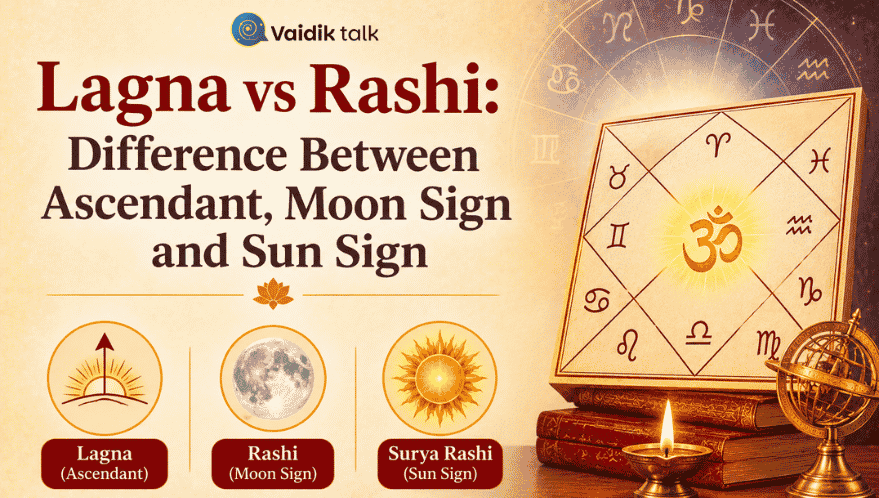
Lagna vs Rashi is a common source of confusion for people reading their first Kundli. One report may describe someone as a Cancer Ascendant, another may mention a Taurus Rashi, while a birthday horoscope identifies a different Sun sign. These labels can all refer to the same person because they describe different chart positions.
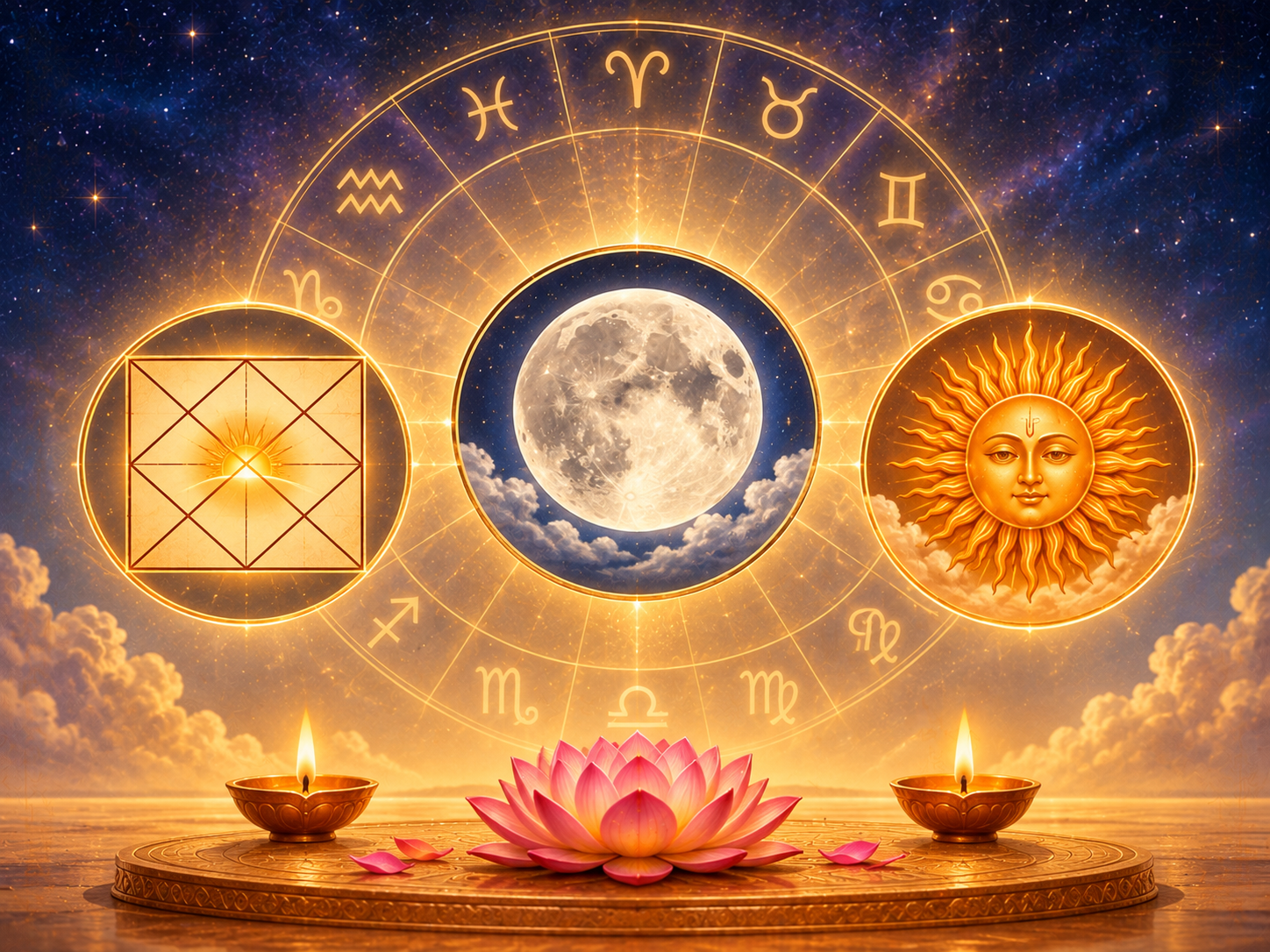
The distinction is straightforward: Lagna is the rising sign, Janma Rashi is the Moon sign, and Surya Rashi is the Sun sign. However, Rashi itself means a zodiac sign. In everyday Indian astrology discussions, the word commonly refers to the Moon sign unless another reference is specified.
Astrological signs divide the zodiac into 12 sections of 30 degrees, as explained in Britannica’s zodiac reference. Lagna, Moon sign and Sun sign identify different positions within this framework.
Readers unfamiliar with chart terminology can begin with what a Kundli represents and the foundations of Vedic astrology.
Lagna, Rashi and Sun Sign
Lagna Meaning in Astrology
Lagna meaning in astrology refers to the zodiacal point rising on the eastern horizon at a particular time and place. The sign containing that point is the Ascendant or rising sign.
Britannica’s historical discussion of astrology describes the connection between the eastern horizon and the ascendant.
In Vedic interpretation, Lagna provides a reference for studying the body, personal approach and life circumstances. Its ruling planet, called the Lagna lord, is examined alongside other placements.
In a whole-sign chart, the rising sign becomes the first house, and subsequent signs form the remaining houses. Other house-calculation methods can produce different boundaries.
Rashi and the Moon Sign
Janma Rashi is the sign occupied by the Moon at birth. Traditional astrologers associate it with emotional patterns, instinctive responses, mental experience and a sense of security.
The Moon’s birth Nakshatra also provides the starting reference for calculating Vimshottari dasha. This is more specific than knowing the Moon sign alone.
NASA states that the Moon completes an orbit around Earth in approximately 27.3 days. This is different from its roughly monthly cycle of visible phases, explained in NASA’s Moon questions resource.
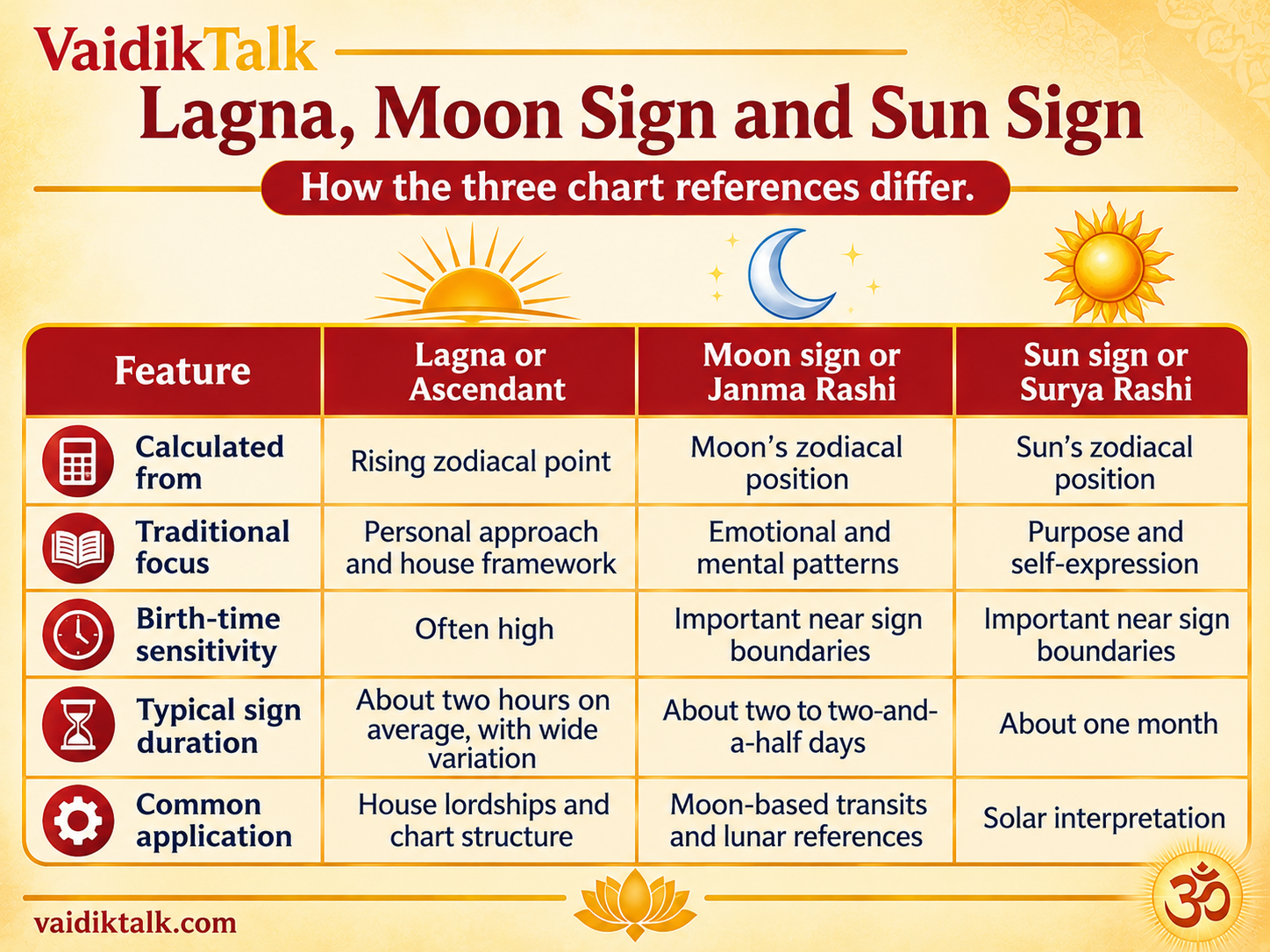
Astrologically, the Moon spends approximately two to two-and-a-half days in each sign, with actual timing varying.
The Sun Sign
The Sun sign is the zodiac sign occupied by the Sun at birth. Traditional interpretations connect it with purpose, authority, confidence and self-expression.
It changes approximately monthly, making it less sensitive to birth time than the Ascendant in many cases. Birth time still matters near a sign boundary.
Popular Western birthday horoscopes usually use the tropical zodiac. Many Vedic charts use a sidereal zodiac, so their Sun-sign results may differ.
Moon Sign vs Ascendant
The Moon sign vs ascendant distinction concerns both calculation and interpretation. One describes the Moon’s location; the other depends on the local eastern horizon.
Why Accurate Birth Time Matters
Earth rotates once in approximately 23.9 hours, according to NASA’s Earth facts. The changing local horizon makes the Ascendant sensitive to time and location.
The familiar “two hours per rising sign” statement is only an average. Latitude, season and the angle of the zodiac affect how long individual signs take to rise.
A small recording error does not change every person’s Lagna. It becomes particularly important when the Ascendant is near a sign boundary. Even without a sign change, the rising degree may shift.
Why Two People Can Share a Rashi
Two people born while the Moon occupies Taurus can share Taurus Rashi but have different Ascendants. Their house arrangements and planetary relationships may therefore differ.
This explains why Moon-sign horoscopes are broad. Sharing a Rashi does not establish identical personalities, relationships or life events.
The Lagna vs Rashi distinction is especially useful when someone relates to one horoscope description but not another.
How the Signs Work Together
A Simple Chart Illustration
Consider a hypothetical person with:
- Cancer Lagna
- Taurus Moon
- Leo Sun
A traditional reading might associate Cancer Lagna with a protective personal approach, Taurus Moon with a preference for emotional steadiness, and Leo Sun with purposeful self-expression.
These descriptions are symbolic starting points. They do not establish a psychological profile or predict behaviour.
In the same whole-sign chart, Taurus becomes the eleventh house from Cancer, while Leo becomes the second. The Moon and Sun would therefore be interpreted through their houses, rulerships, aspects and other chart relationships.
Which Sign Matters Most?
There is no single answer suitable for every astrological technique.
Lagna commonly anchors house-based interpretation. The Moon is important for lunar transits and the birth of Nakshatra. The Sun contributes its own symbolism and house relationships.
For example, Sade Sati is traditionally assessed through Saturn’s transit relative to the natal Moon. It should not be confused with Kaal Sarp Dosh, which concerns a different planetary arrangement.
Readers can compare Kaal Sarp Dosh and Sade Sati for further context.
Compatibility and Planetary Yogas
The Moon sign vs ascendant question also appears in marriage discussions. Moon-based factors can contribute to traditional matching, but a full assessment may consider the Ascendant, seventh house, Venus, Jupiter and other placements.
Our comparison of Kundli matching and Guna Milan explains this wider context. Manglik Dosh involves separate considerations.
Likewise, Gajakesari Yoga, Neech Bhang Raj Yoga, and other Raj Yogas require more information than a single sign.
Finding and Reading the Signs
Information Required
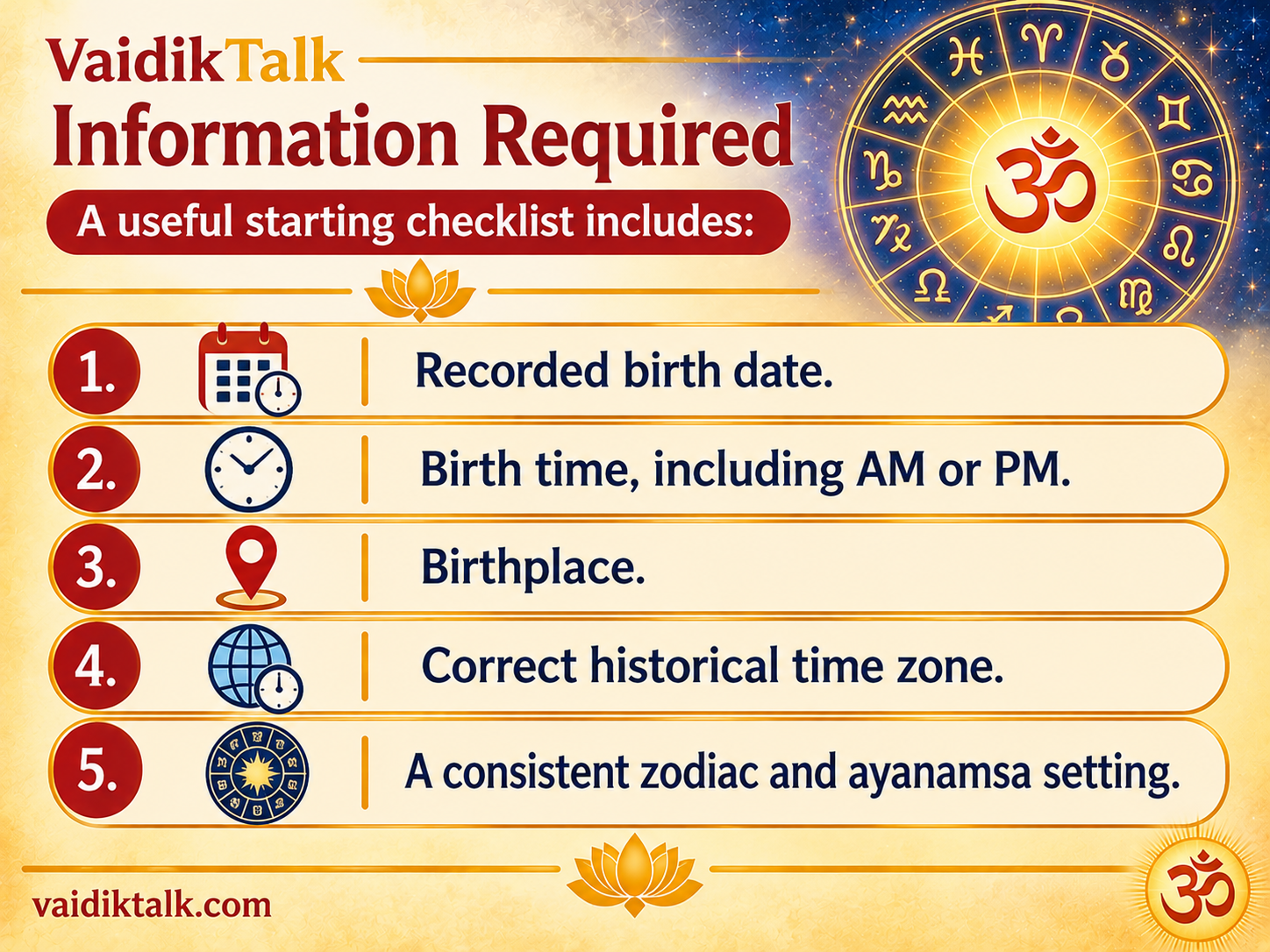
A chart calculator then identifies the Ascendant and planetary positions. Readers comparing providers can review Kundli-making services and report options.
Why Calculators Disagree
Differences can result from tropical versus sidereal settings, different ayanamsas, daylight-saving adjustments, time-zone errors or inaccurate location details.
A house-system change can alter house boundaries without necessarily changing a planet’s zodiac sign. Meanwhile, changing the zodiac framework may change the displayed sign itself.
Understanding Lagna meaning in astrology helps separate these issues instead of assuming that every conflicting result is a calculation error.
If birth time is unknown, a responsible reader should acknowledge uncertainty. Birth-time rectification is an interpretive exercise, not a substitute for a reliable record.
Related Practices and Products
Other spiritual systems address different questions. Nadi and Vedic astrology, numerology, and life path numbers should not be treated as equivalent calculations.
Similarly, Vastu practices for prosperity concern traditional spatial principles rather than birth-sign identification.
For devotional interests, readers can explore Rudraksha’s spiritual significance, traditional and buyer-reported benefits, and certification considerations.
VaidikTalk Store lists a 5 Mukhi Rudraksha bracelet and a Rudraksha Kantha Mala. Such items do not change a person’s birth signs.vaidiktalk+1
Gemstone purchases also require separate consideration, including the differences between emerald and peridot.
Conclusion: Reading the Complete Chart
Lagna vs Rashi is best understood as a distinction between reference points, not competing identities. Lagna identifies the rising sign, Janma Rashi identifies the Moon sign, and Surya Rashi identifies the Sun sign.
Britannica describes astrology as a form of divination. Its interpretations should remain separate from established medical, psychological or financial assessments.
For help understanding Moon sign vs ascendant or clarifying Lagna meaning in astrology, readers can contact Vaidik Talk to discuss consultation options.
Frequently Asked Questions
Are Lagna and Rashi the same?
Lagna is the rising sign, while Rashi commonly refers to the Moon sign in everyday Indian astrology.
Can all three signs match?
Yes, the Ascendant, Moon and Sun can occupy the same zodiac sign.
Can Lagna be found without birth time?
An accurate Lagna generally requires birth time and birthplace.
Why does a Vedic Sun sign differ from a Western one?
Different zodiac frameworks, commonly sidereal and tropical, can produce different sign labels.
Which detail should be checked first when results conflict?
The birth data, time-zone entry and zodiac settings should be checked before interpreting the chart.