

Whenever bad luck is taught or discussed, especially in the context of vedic astrology there are two terms that you will surely come across. Although it is also related to a period of misfortune. Yes, you guessed it right these two terms are Kaal Sarp Dosh and Sade Sati.
These two terms are so commonly used together that you can easily see people linking one to the other. A lot of people believe that both expressions are one and the same thing. In this piece of content, we will discuss the very difference between Kaal Sarp Dosh and Sade Sati. Along with that we will highlight the types of afflictions they bring to people’s lives and how astrologers tend to work on each of them. Let’s get started.
The Core Difference Between Kaal Sarp and Sade Sati
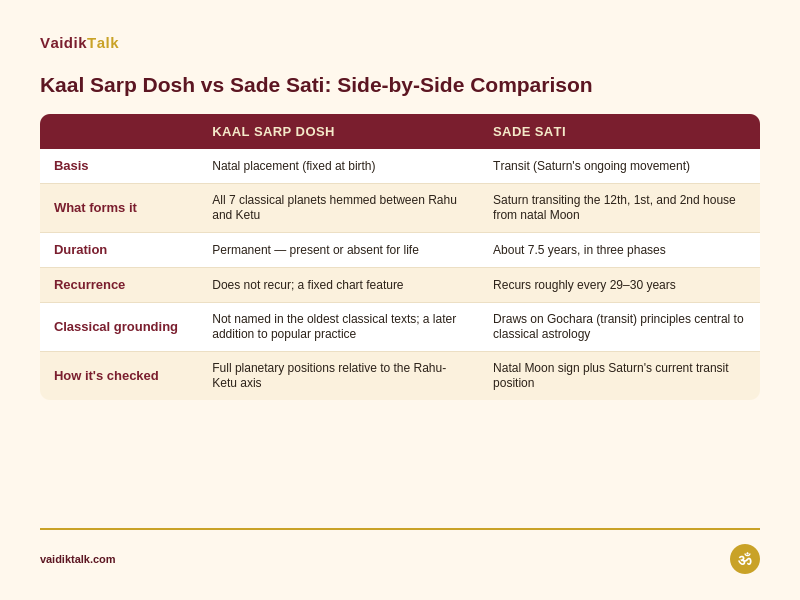
What is the main difference between Kaal Sarp and Sade Sati? I believe it is the location of these aspects in the chart. To be more precise, Kaal Sarp Dosh is a natal dash, which is fixed in time. Sade Sati is a transit dash, related to the wandering of Saturn. Thus, the difference between Kaal Sarp and Sade Sati determines the difference in their influences.
Therefore, when you understand the primary difference between two cases, you will perceive the difference in their effects. In addition, now, having grasped this simple explanation, the subsequent discussion of the characteristics of each dash will become much clearer.
Kaal Sarp Dosh: A Fixed Natal Placement
Kaal Sarp Dosh happens when all 7 classical planets Sun, Moon, Mars, Mercury, Jupiter, Venus, and Saturn gather between Rahu and Ketu. This is directly dependent on the planetary positions at the time of birth, This never alters is permanent for each person throughout their life. It either exists or does not exist in a person’s horoscope for all eternity. As explained in greater detail in the Vaidik Talk series on Kaal Sarp Dosh, this arrangement of planets is never mentioned in any of the classical ancient scriptures and was added as a later development by the popular astrology community.
Sade Sati: A Recurring Saturn Transit
Sade Sati is another form of Saturn transit, it happens when the planet Saturn transits the 12th house, which is a person’s Moon house and the 2nd house from that person’s own Moon sign. The thing to remember here is that it requires Saturn approximately 2.5 years to transit any zodiac sign, this whole span goes on for around 7.5 years, hence the name is given to the dosha. In contrast to Kaal Sarpdosham, Sade Sati is based on the principle of Gochara (transit). Sade Sati is close to the core principles of classical astrology. Most traditional schools of Indian astrology actually embrace Saturn’s transits and believe that they have to be taken seriously, despite their different approach to natal charts.
Kaal Sarp Dosh vs Sade Sati: Side-by-Side Comparison
Here is a table below which offers the dosh comparison astrology readers ask about -
Can a Chart Have Both at the Same Time?
A birth chart can carry both at once, and this is where a lot of the confusion between these two actually starts. Since Kaal Sarp Dosh is a fixed natal feature and Sade Sati is a recurring transit, nothing rules out having both active during the same period. Someone with Kaal Sarp Dosh along with Sade Sati may have to go through a heavier stretch which will never be created in the first place.
How to Tell Which One Applies to a Chart
Working out which one applies, or whether both do cannot be determined by the result of evaluation of a horoscope column. Checking for Kaal Sarp Dosh requires a full birth chart with every planet's exact position relative to the Rahu-Ketu axis, since even one planet sitting outside the hemmed pattern changes the picture from a full formation to a partial one. Checking for Sade Sati is comparatively more direct, since it mainly requires knowing a person's Moon sign and Saturn's current position, though pinning down which of the three phases someone is in still needs an accurate chart.
A rough shortcut helps in everyday conversation: a period that appears to be starting and will eventually end points toward Sade Sati, while a pattern that seems to have been part of a chart from the beginning points toward Kaal Sarp Dosh.
Why the Confusion Happens
Part of the dosh comparison astrology confusion comes from how both terms circulate in everyday conversation, often stripped of the context that would actually distinguish them. Content aimed at quick answers tends to compress "a difficult Saturn period" and "a difficult planetary combination" into interchangeable warnings, when the underlying mechanics one fixed, one cyclical are genuinely different. The problem is with making assumptions, when anyone raises a dosh comparison astrology question without proper knowledge, it leads people to assume both terms describe the same experience.
Why Sade Sati Follows a Predictable Rhythm
Saturn's own orbit is part of why Sade Sati follows such a consistent pattern. According to NASA, it requires Saturn around 29.4 Earth years to complete one orbit of the Sun. This is also a prominent reason why people come across a full Sade Sati cycle every three decades. Remember that Kaal Sarp Dosh has no equivalent cycle.
Where to Get an Accurate Reading
For anyone trying to work out which of these applies to their own chart, Vaidik Talk's dedicated guides go deeper into each one individually: the article on Kaal Sarp Dosh covers the twelve types and their remedies, while the guide on Sade Sati breaks down all three phases and what each one tends to bring. Readers newer to birth charts altogether may want to start with the guide on what is Vedic astrology, which explains how a kundli gets built from birth details in the first place.
An accurate answer starts with an accurate chart. Vaidik Talk's Kaal Sarp Dosh Report checks the full planetary layout against the Rahu-Ketu axis, and the Sade Sati and Dhaiya Report confirms the Moon sign and current Saturn transit phase directly, rather than relying on a general Moon-sign horoscope. For a conversation about what a specific chart shows, it also helps to talk to an Astrologer directly, since a mixed picture, where both factors are present, usually calls for a combined remedy approach rather than treating each one separately.
Getting the Right Guidance
People confuse both the doshas a lot. but the technicality and mechanics behind both of them are very different. It is imperative that people should know the difference between Kaal Sarp and Sade Sati. Any person that feels that either of these doshas are present in their lives should definitely connect with us through the Contact Us page, and our team will guide you in the right direction with proper consultation.
Frequently Asked Questions
Is Kaal Sarp Dosh worse than Sade Sati?
Again, it is a notion in people, none of them are extremely worse but the effects of both the doshas rely on the chart.
Does Kaal Sarp Dosh end at some point?
No, a kaal sarp dosh always stays part of the chart for life but this is not the case with Sade Sati.
Can a person go through Sade Sati more than once?
Yes, it comes around every 3 decades as Saturn completes its orbit around the Sun.
Do the two doshas share the same remedies?
Some remedies overlap, such as certain pujas, but each dosha also has remedies specific to its own planetary cause.
How can someone check both at once?
A full chart reading that includes planetary positions and current transits is the only reliable way to check for both together.