Anyone who asks what are the benefits of Rudraksha for the first time will most likely imagine a necklace of dark, uneven beads, worn by a sadhu, a family elder, or perhaps increasingly common in everyday life, a stranger on the street, wondering what this object signifies. Rudraksha is a seed used as a prayer bead in Hinduism and Buddhism. It has a botanical definition and a more intriguing mythological one. In this content piece, we will exhaustively talk and discuss the rudraksha meaning, its origins according to both scripture and science, and last but not the least, its role in Hinduism and in daily lives of people.
Rudraksha Meaning: What the Word Actually Says
The rudraksha meaning comes from the Sanskrit words Rudra, which is one of the names of Shiva, and aksha, which means either an eye or a tear. Therefore, the rudraksha actually translates into either “the eyes of Rudra” or, more commonly, “Shiva’s tears.” The second meaning is not a coincidence because there is a mythological background to it. Rudraksha is said to have been created from Shiva’s tears. It is also believed that rudraksha beads help counter certain astrological transgressions. Vaidik Talk's guide to Kaal Sarp Dosh is in fact illustrative of the manner in which specific doshas are conventionally linked to recommended remedial actions, including rudraksha.
Origin of Rudraksha: Mythology and Puranic Accounts
The Puranic Origin Story
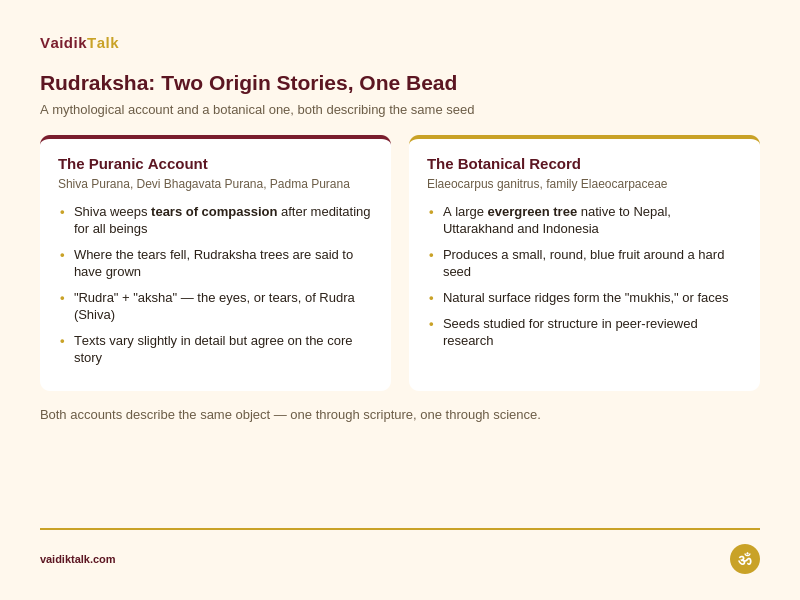
As per Shiva Purana, Devi Bhagavata Purana, and Padma Purana, Rudraksha originated from tears of compassion of Lord Shiva which fell on the land while he was meditating to grant welfare to all living beings hence the rudraksha spiritual benefits were derived. From the place where his tears fell, Rudraksha trees grew. The stories in different Puranas seem to be slightly different, and they contradict each other, but they all correlate the origin of the sacred bead with Lord Shiva’s compassionate tears, not mere decoration.
Botanical Origin: The Real Tree Behind the Bead
Removed from the realm of mythology, the origin of rudraksha has a simple explanation. The bead is the dried seed of Elaeocarpus ganitrus, a large evergreen tree of the family Elaeocarpaceae, which bears small rounded blue fruits, which have earned the seed its alternate name of blueberry bead in botanical taxonomy. The tree is distributed across India, Southeast Asia, and is particularly associated with the Nepalese Himalayas and the Indian state of Uttarakhand and Indonesia. The pharmacognostic study published on PubMed Central provides the precise anatomical description of the fruit from which the rudraksha bead is made, which is further found to have a hard endocarp of a cellular texture, separate from any esoteric context that may be associated with the bead otherwise.
The seed's surface carries natural vertical ridges, or lines, known as mukhis, meaning faces. A Rudraksha bead can have 1 to 21 mukhis; it is said that each number has its own significance, which is why certain beads are more sought after than others.
Rudraksha in Hinduism: How It's Actually Used
The role of benefits of Rudraksha in Hinduism is sacred. It is mainly used as a prayer bead, which is usually made of a mala or a string of 108 beads plus one additional bead, the guru bead, counting the number of mantra repetitions during japa, a meditative activity. It is strongly associated with Shaivite tradition and is mainly worn by ascetics and those practicing Shiva living within Hinduism, but its use goes beyond these communities, being used both within other Hindu practices and Buddhism, where it also serves for counting and keeping track of repetitive prayers. Worn daily, it is believed to help keep a calm mind and focus, which also explains why benefits of Rudraksha is often mentioned alongside Vedic remedies, as both are used for similar purposes, which is also explored on the Vaidik Talk website in the Vedic astrology section.
Common Mukhi Counts at a Glance
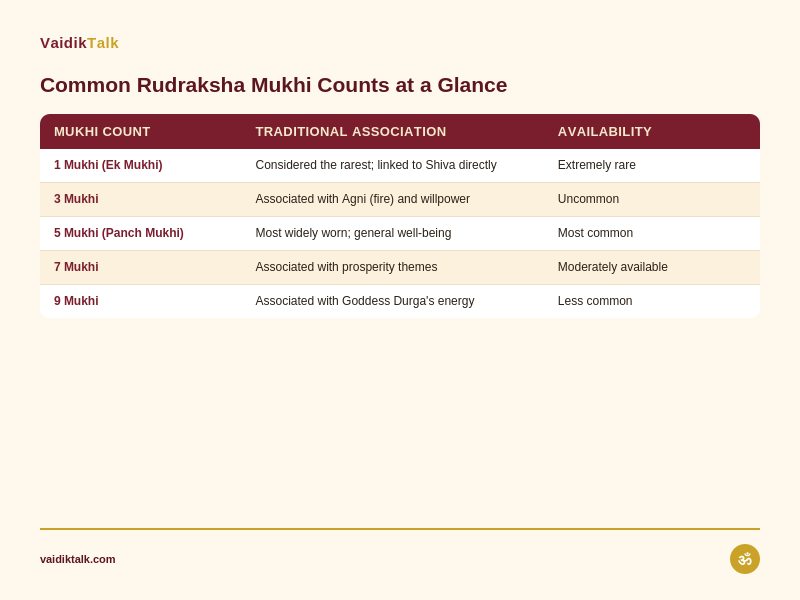
Why Mukhi Count Matters
Each mukhi relates to a different presiding deity and to a different goal, so it is natural that customers shopping for Rudraksha ask about the mukhi number. A single-faced, or Eek Mukhi, bead is the rarest and most desired in most traditions while five-faced beads are the most common and widely worn. The information given here is a general overview, as an entire discussion of the specific meanings of each mukhi would fill a volume many times over and beyond.
Getting Started
Readers who want to see genuine Rudraksha beads and rudraksha health benefits can directly browse Vaidik Talk's Rudraksha collection or the Siddh Rudraksha collection for beads prepared according to traditional ritual practice. For anyone comparing Rudraksha against other remedy objects, Vaidik Talk's guides on the best pyrite bracelet for money and prosperity and pyrite vs citrine cover a different category, crystal healing, worth understanding as a separate tradition from Rudraksha's Vedic and Puranic roots. Readers focused specifically on career-related remedies may also find the guide on best gemstone for career growth useful for comparing gemstone-based options alongside Rudraksha.
Getting the Right Guidance
Rudraksha carries with it a documented botanical identification, as well as a significantly older mythological one, and knowing both makes evaluating any claims concerning individual beads much simpler. Once the basics of what is Rudraksha are understood, any other questions relating to a single bead are much easier to evaluate. Anyone who has questions concerning which Rudraksha suits their needs can contact us on the Contact Us page, and we will advise them on what product to acquire or otherwise give them the information they are looking for.
Frequently Asked Questions
Rudraksha is only used in Hinduism, correct?
It is partially true, as rudraksha is used mainly as prayer beads in Buddhist traditions. They are heavily associated with Hinduism.
Can anyone wear rudraksha beads, or is it limited to certain groups of people?
It is considered to be beneficial for almost all people, regardless of their religion or beliefs, with the exception of certain mukhi counts, particularly attached to certain religions and practices.
Does the number of mukhi (faces) affect the cost of the rudraksha bead?
It certainly does, as rare mukhi counts, such as the highly sought-after single mukhi, have significantly higher prices on the market due to their scarcity.
Is rudraksha bead the same as regular wood?
It is the seed of a tree, which has a unique structure on the inside, as well as a specific ridge pattern on the outside.
How can one distinguish a real rudraksha from fake?
Real rudraksha beads have a subtle ridge pattern on them, while fake ones have an overly precise, artificial structure.