Before any Vedic astrology reading can actually begin, one document has to exist first. Anyone asking what is Kundli is really asking about that starting document, the birth chart every later reading, remedy, or prediction gets built from. Vaidik Talk's guide on what is Vedic astrology covers the broader tradition that all sits within. This guide covers the kundli meaning behind the word, walks through a birth chart explained section by section, and covers janam kundli basics anyone should know before their first reading.
Kundli Meaning: Where the Word Comes From
The kundli meaning traces back to the Sanskrit word kundala, related to a coiled or circular form, reflecting the traditional circular or diamond shaped diagram used to map planetary positions at a specific moment. In everyday use, kundli refers to the full document that records where each planet sat in the sky at the time of a person's birth, along with the resulting houses, signs, and calculated periods that follow from that placement. Janam kundli specifically refers to a birth chart, since janam means birth in Hindi, distinguishing it from other kinds of charts cast for events like a wedding date or a business launch.
What a Kundli Actually Contains
The whole birth chart explained simply comes down to a few core elements working together. According to Britannica's entry on Jyotisha, the Hindu astrological tradition a kundli is built from, the system relies on lunar mansions called nakshatras, planetary combinations called yogas, and planetary periods called dashas, along with the navagraha, the nine celestial bodies tracked in the system. A kundli maps all of this onto a chart divided into twelve houses, each representing a different area of life. Readers weighing gemstone remedies tied to specific planetary weaknesses shown in a chart may find Vaidik Talk's guide on best gemstone for career growth useful for context on how that connects back to a kundli.
The 12 Houses (Bhavas)
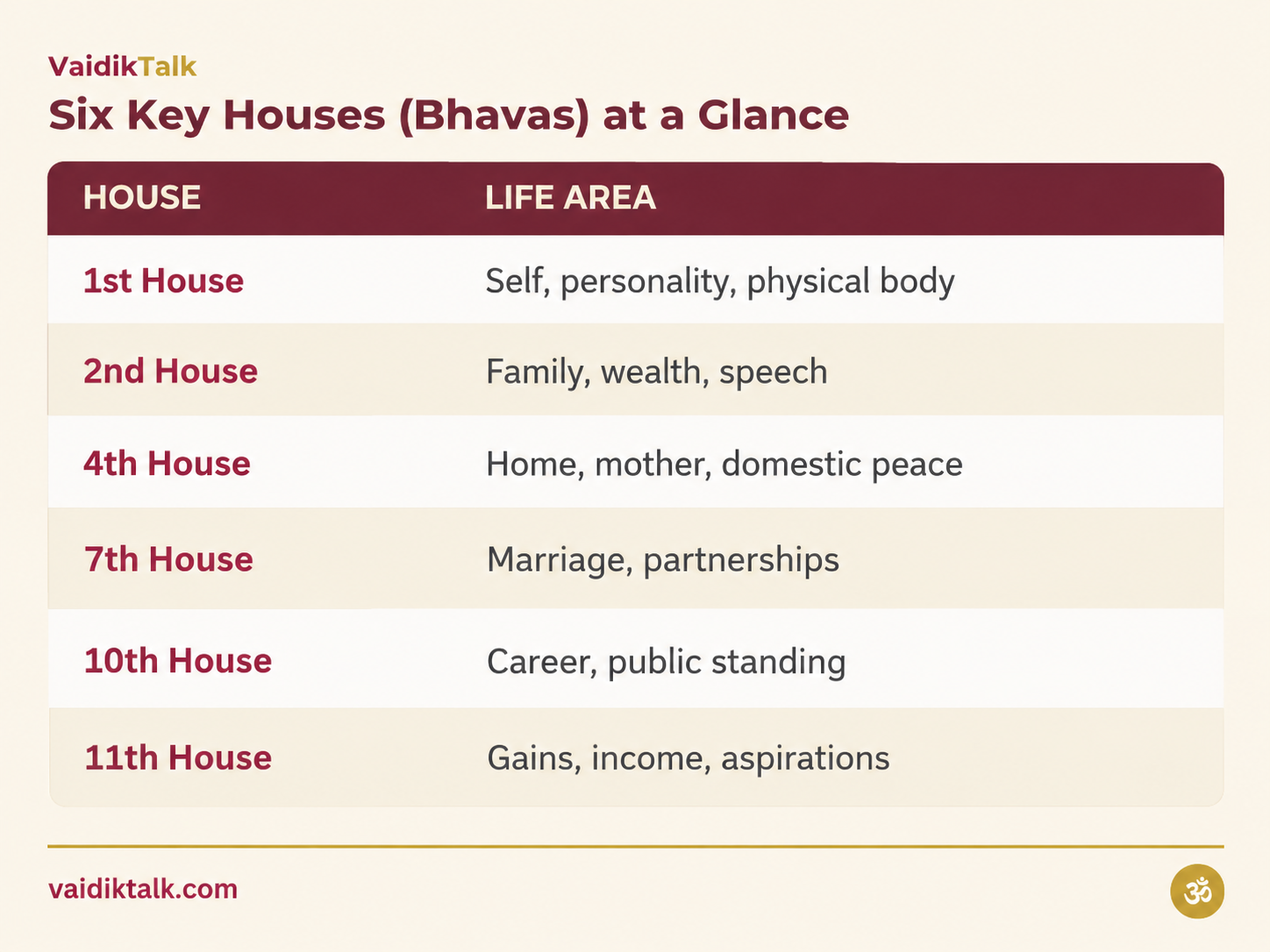
Each house, or bhava, spans thirty degrees of the chart and governs a specific life area, from self and personality in the first house to career in the tenth and gains in the eleventh. Where a planet falls among these twelve houses shapes how that planet's general qualities are read in the context of a specific chart, which is why two people with the same sun sign can still receive very different readings.
Six Key Houses at a Glance
Nakshatras and Why They Matter
Nakshatras add another layer of detail beyond the twelve houses. Britannica's entry on nakshatras explains that the Hindu calendar system has divided the sky into 27 or 28 lunar mansions since roughly 1000 BCE, based on where the Moon rises daily across a lunar month. A person's nakshatra is determined by their exact birth date, time, and location, and it's believed to influence areas including personality, relationships, and career, working alongside the twelve houses rather than replacing them.
Janam Kundli Basics: What's Needed to Build One
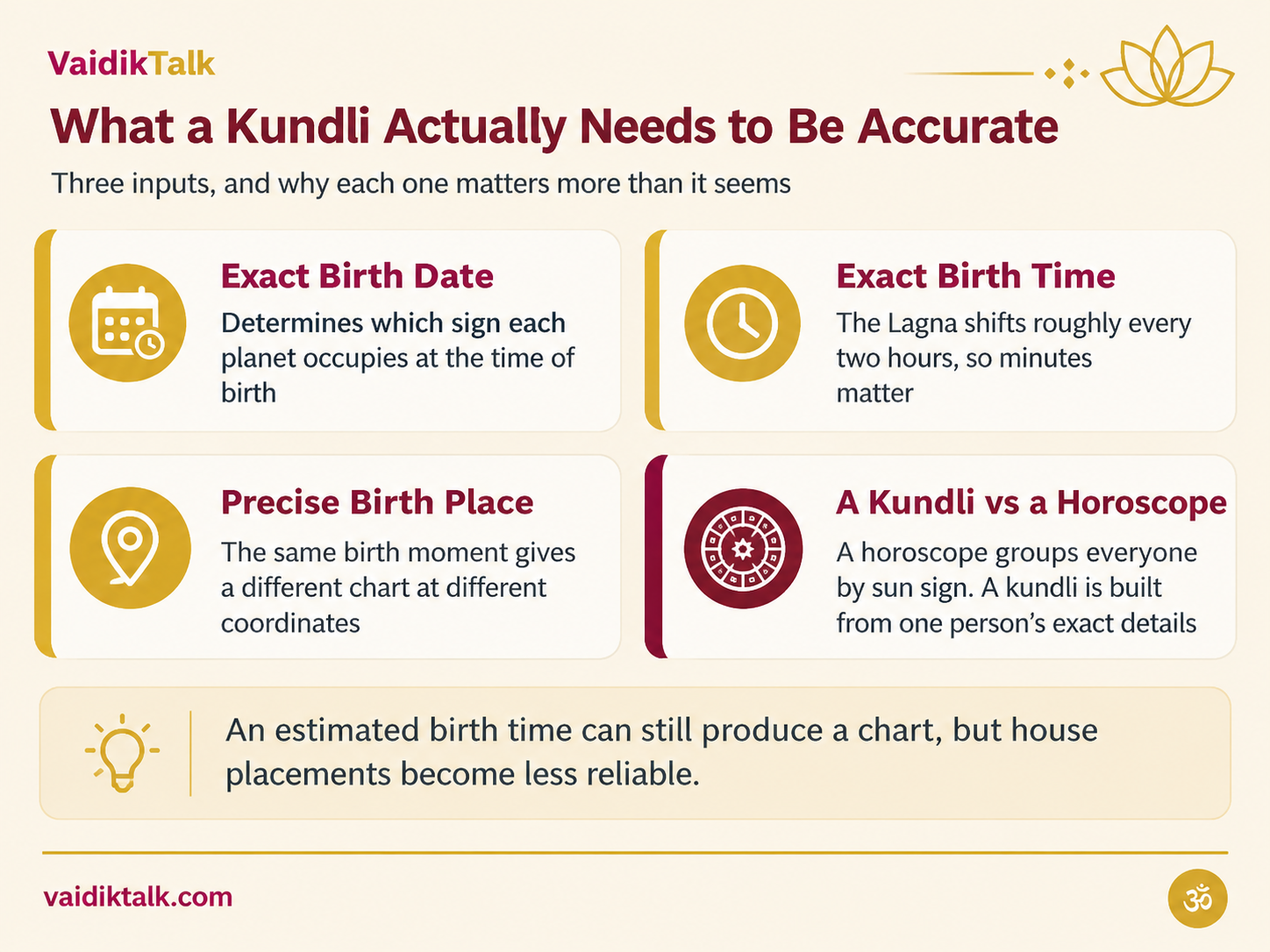
Janam kundli basics start with three specific pieces of information: exact date of birth, exact time of birth, and precise place of birth. Time matters more than most people expect, since the ascendant, or Lagna, the sign rising on the eastern horizon, changes roughly every two hours, and even a difference of a few minutes can shift which house a planet falls into. Place matters for a similar reason, since the same birth moment produces a different chart depending on the exact coordinates used for the calculation. These janam kundli basics are why an estimated or rounded birth time often produces a chart that looks reasonable but carries real inaccuracies in its house placements. Anyone dealing with a specific placement, such as concerns tied to Kaal Sarp Dosh, may find that guide relevant too, since it depends on the same kind of full, accurately calculated chart described here.
How a Kundli Differs from a Daily Horoscope
A common point of confusion is treating a kundli and a daily horoscope as the same thing. A daily horoscope groups everyone born under one sun sign into a single, general prediction. A kundli is calculated from one specific person's exact birth details and reflects the full arrangement of all nine planets across twelve houses, not just the sun's position. This is also why two people who read the same daily horoscope can have completely different kundlis once their full birth details are factored in. Readers who want a sense of how documented facts get separated from marketing claims in a comparable context may find Vaidik Talk's guide on pyrite vs citrine useful for the same kind of evidence based approach applied here.
Getting Started
Readers who want to see their own chart built from scratch can use Vaidik Talk's Kundli Generation tool with accurate birth details entered directly. For remedy objects related to specific planetary weaknesses shown in a kundli, the guide on best pyrite bracelet for money and prosperity is worth reading as well.
Getting the Right Guidance
A kundli is the foundation nearly everything else in Vedic astrology builds from, which is why getting the birth details right at the start matters more than any single reading that follows. Anyone with questions about their own chart can reach out through the Contact Us page, and the team will point them to the right report or consultation.
Frequently Asked Questions
Is a kundli the same as a horoscope?
Not exactly, a kundli is the full birth chart calculated from exact birth details, while a horoscope column usually gives general predictions based only on sun sign.
Can a kundli be generated without an exact birth time?
It can, but the ascendant and house placements become less reliable without a precise time, since these shift roughly every two hours.
How many houses does a kundli have?
Twelve houses, each representing a different area of life, from personality and self to career, relationships, and gains.
What is the difference between a kundli and a janam kundli?
They generally refer to the same thing, a birth chart, with janam kundli specifically emphasizing that it's calculated from birth details.
Do all astrologers read a kundli the same way?
No, different schools within Vedic astrology, such as Parashari and Jaimini, use different techniques to interpret the same underlying chart.