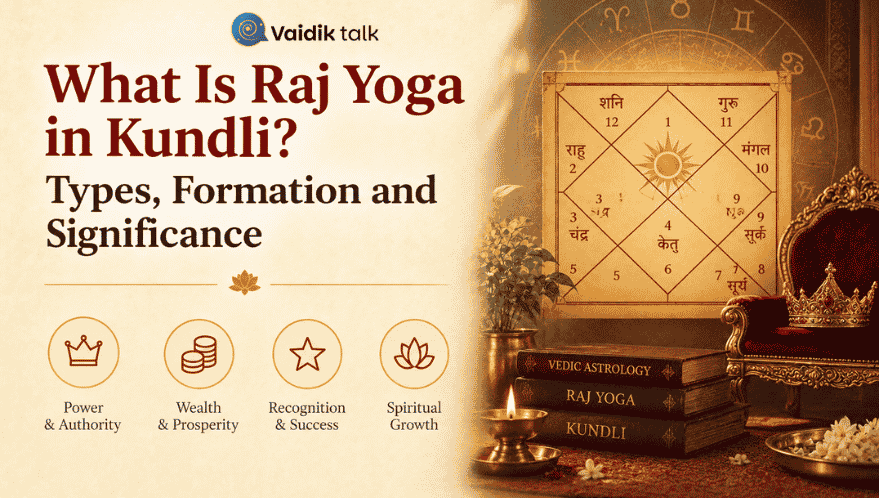
Raj Yoga in Kundli is a traditional Vedic astrology term for favourable planetary combinations associated with authority, recognition, progress, influence and access to opportunities. The word Raj means royal or kingly, while Yoga refers to a meaningful planetary combination in a birth chart.
In modern life, Raj Yoga does not literally mean that a person becomes a king or holds political office. In Raj Yoga astrology, it may be interpreted as potential for professional growth, leadership, social respect, responsibility, public visibility or success in a chosen field. Its results are traditionally assessed through the whole Kundli, including planetary strength, house placement, aspects, divisional charts and dasha periods. A general overview of Raj Yoga combinations describes its association with favourable house-lord connections.
To understand this topic properly, readers may begin with what a Kundli is and how a birth chart is interpreted. A Kundli is a map of planetary placements at birth, and no single yoga should be read separately from the rest of that map.
What Does Raj Yoga Mean?
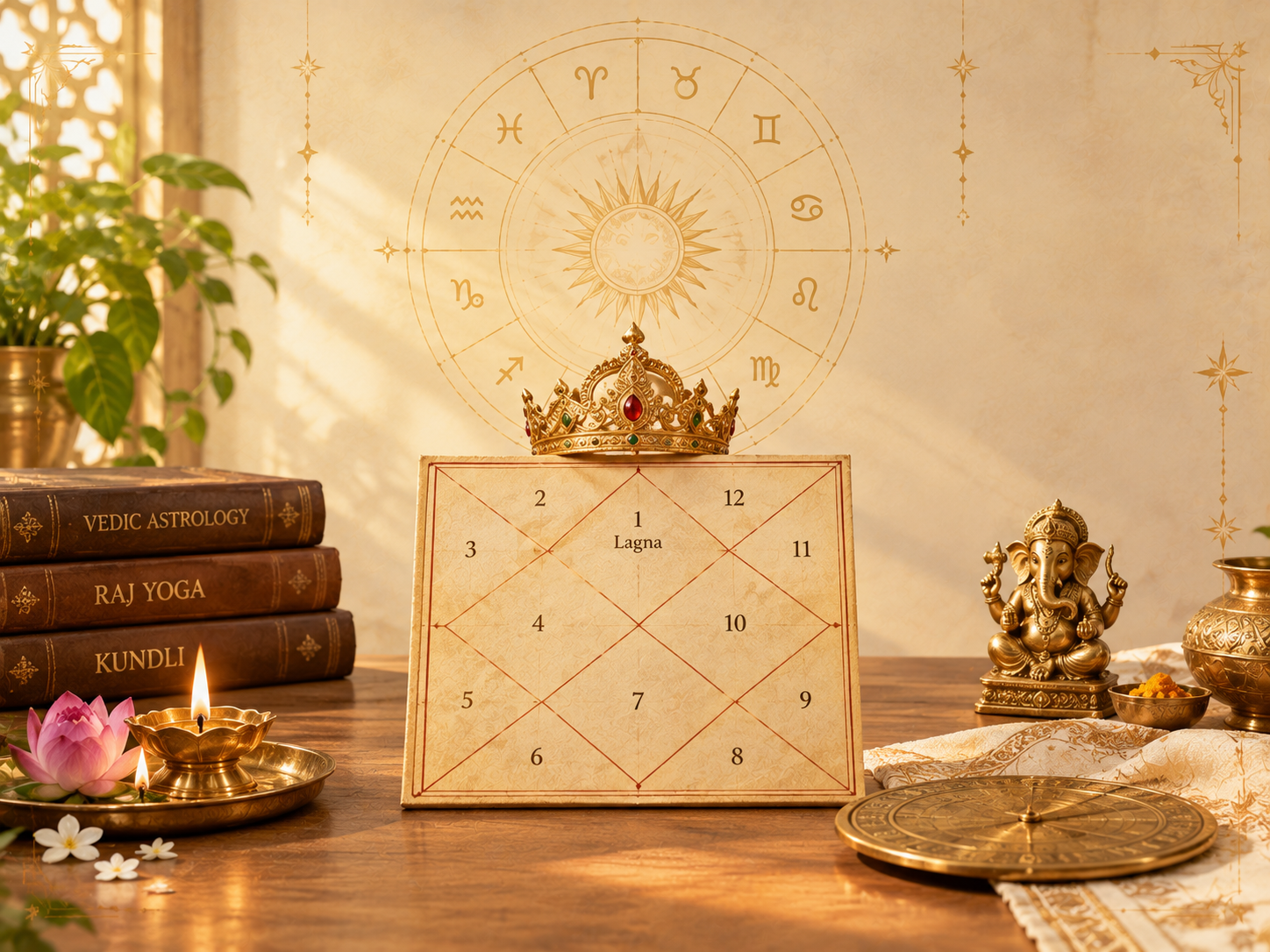
In classical Jyotish, Raj Yoga is commonly formed through a relationship between the lords of Kendra houses and Trikona houses. Kendras are the first, fourth, seventh and tenth houses. Trikonas are the first, fifth and ninth houses.
The Kendra houses are connected with core areas of life:
- First house: Identity, physical presence and personal direction.
- Fourth house: Home, emotional foundations, property and comfort.
- Seventh house: Partnerships, public dealings and commitments.
- Tenth house: Career, actions, reputation and public role.
The Trikona houses are traditionally viewed as supportive or auspicious:
- First house: Personal effort and self-development.
- Fifth house: Learning, creativity, intelligence and children.
- Ninth house: Dharma, mentors, higher learning and fortune.
In Raj Yoga astrology, a connection between these house lords may occur through conjunction, mutual aspect or exchange of signs. Classical interpretations see this as a link between personal merit, action, opportunity and status. An explanation of Kendra and Trikona combinations outlines this traditional rule.
Why Raj Yoga Depends on the Full Chart
Yoga can sound powerful on paper, yet its expression may differ greatly from person to person. A skilled astrologer studies the full context before drawing conclusions.
Factors commonly assessed include:
- The strength of the Ascendant and its lord.
- The signs occupied by the planets involved.
- Whether a planet is exalted, debilitated, in its own sign or placed in a friendly sign.
- Aspects from benefic or challenging planets.
- Combustion, retrogression and planetary dignity.
- The house placement of the planets forming the yoga.
- The operating Mahadasha and Antardasha.
- Divisional charts, especially the Navamsa and Dashamsa.
For this reason, how to identify Raj Yoga in Kundli is not as simple as spotting two planets together. A conjunction may form one part of the pattern, while timing and overall planetary condition shape how it is traditionally interpreted.
Core Formation of Raj Yoga
Kendra and Trikona Lord Connection
The classic form of Raj Yoga in Kundli arises when a Kendra lord connects with a Trikona lord. The connection may take several forms:
- Conjunction: Two house lords occupy the same sign or house.
- Mutual aspect: The planets aspect each other according to Vedic aspect rules.
- Parivartana Yoga: The planets exchange signs.
- Placement relationship: One lord occupies the other lord’s sign in a meaningful configuration.
For example, if the lord of the ninth house and the lord of the tenth house form a strong relationship, traditional astrology may view it as supportive for work, purpose, mentorship and recognition. The ninth house is linked with fortune and ethical direction, while the tenth house relates to public action and career.
A person should remember that chart interpretations are faith-based. Astrological combinations cannot guarantee wealth, fame, marriage, health or a particular profession. Education, effort, opportunities, support systems and personal choices remain central in real life.
The Role of the First House
The first house, or Lagna, belongs to both the Kendra and Trikona categories. This makes the Lagna lord highly important in Raj Yoga astrology.
When the Ascendant lord forms a beneficial connection with a fifth, ninth or tenth-house lord, astrologers may examine it closely. Such a relationship can be associated with confidence, direction and the ability to act on opportunities, subject to the full chart.
Accurate birth details matter because the Ascendant can change quickly. Readers who need a chart can explore online Kundli-making services in India and compare options that use the correct date, time and birthplace.
Major Types of Raj Yoga
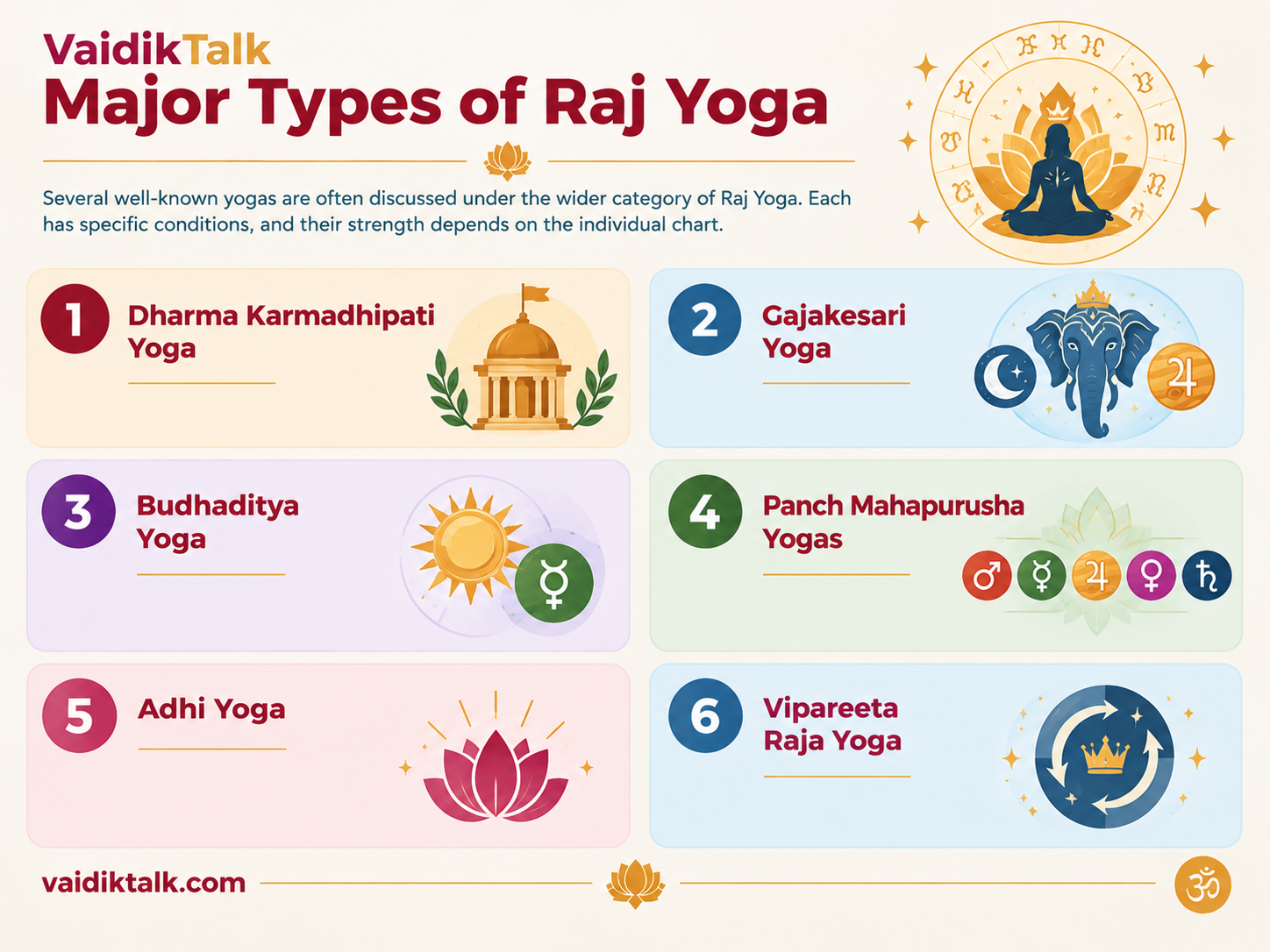
Several well-known yogas are often discussed under the wider category of Raj Yoga. Each has specific conditions, and their strength depends on the individual chart.
Dharma Karmadhipati Yoga
Dharma Karmadhipati Yoga is one of the most discussed forms of Raj Yoga. It involves a connection between the ninth-house lord and the tenth-house lord.
The ninth house is associated with principles, mentors, wisdom and fortune. The tenth house is associated with career, duty, public action and reputation. When their lords connect, traditional interpretation may suggest a link between a person’s values and professional path.
This yoga may be studied for leadership potential, career direction, respect from mentors or growth through ethical work. It should not be treated as a fixed prediction of a job title, income level or public fame.
Gajakesari Yoga
Gajakesari Yoga is traditionally formed when Jupiter is in a Kendra from the Moon. The name combines Gaja, meaning elephant, and Kesari, meaning lion, symbols associated with strength and dignity.
In classical interpretation, this yoga is connected with wisdom, reputation, learning, counsel and social standing. Its outcome depends on Jupiter’s strength, the Moon’s condition, house placement and afflictions.
A person with this pattern may be encouraged to develop skills connected with teaching, advising, public speaking, analysis or responsible leadership. The chart shows symbolic tendencies, while real development comes through practice and opportunity.
Budhaditya Yoga
Budhaditya Yoga occurs when the Sun and Mercury are together in a birth chart. Traditional astrology associates this combination with intellect, communication, learning, administration and business ability.
Its results vary based on the sign, house, Mercury’s distance from the Sun, aspects and the overall chart. If Mercury is too close to the Sun, astrologers may assess combustion, which can modify the interpretation.
This is a useful example of why how to identify Raj Yoga in Kundli needs more than a simple checklist. The same Sun-Mercury conjunction can have different meanings in different Ascendants and houses.
Panch Mahapurusha Yogas
The Panch Mahapurusha Yogas are formed when Mars, Mercury, Jupiter, Venus or Saturn occupies its own sign or exaltation sign in a Kendra house. These five yogas are traditionally named Ruchaka, Bhadra, Hamsa, Malavya and Shasha.
These yogas are often considered powerful because the relevant planet is both strong by sign and placed in a Kendra. Their effect still depends on the house rulership, aspects, dasha and wider chart pattern. Panch Mahapurusha and other Raj Yogas list these traditional categories.
Adhi Yoga
Adhi Yoga is classically assessed from the Moon or Ascendant when benefic planets occupy the sixth, seventh and eighth houses from that reference point. Jupiter, Venus and Mercury are generally treated as natural benefics, though their functional role differs by Ascendant.
Traditional readings associate Adhi Yoga with comfort, resources, position and the ability to handle responsibilities. A complete analysis considers whether the planets are strong, afflicted or placed in supportive signs.
Vipareeta Raja Yoga
Vipareeta Raja Yoga is traditionally connected with lords of difficult houses, often called Dusthana houses, placed in other difficult houses. The sixth, eighth and twelfth houses are commonly included in this group.
Its meaning differs from the standard Kendra-Trikona Raj Yoga. Classical interpretation may associate it with the ability to overcome hardship, defeat obstacles or gain through unusual circumstances. It does not mean a person should expect difficulty or seek remedies out of fear.
Readers can explore Kaal Sarp Dosh causes, effects and traditional remedies for another chart concept that should be examined only in full context.
How to Identify Raj Yoga in Kundli
A practical answer to how to identify Raj Yoga in Kundli begins with a correctly calculated birth chart. The person needs:
- Date of birth.
- Accurate time of birth.
- Place of birth.
The astrologer then follows a structured process.
Identify the Ascendant
The Ascendant determines which signs rule each house. Without it, house lords cannot be assigned accurately. For example, the ninth-house lord changes according to the Ascendant.
Find Kendra and Trikona Lords
Mark the lords of the first, fourth, seventh and tenth houses. Then identify the lords of the first, fifth and ninth houses.
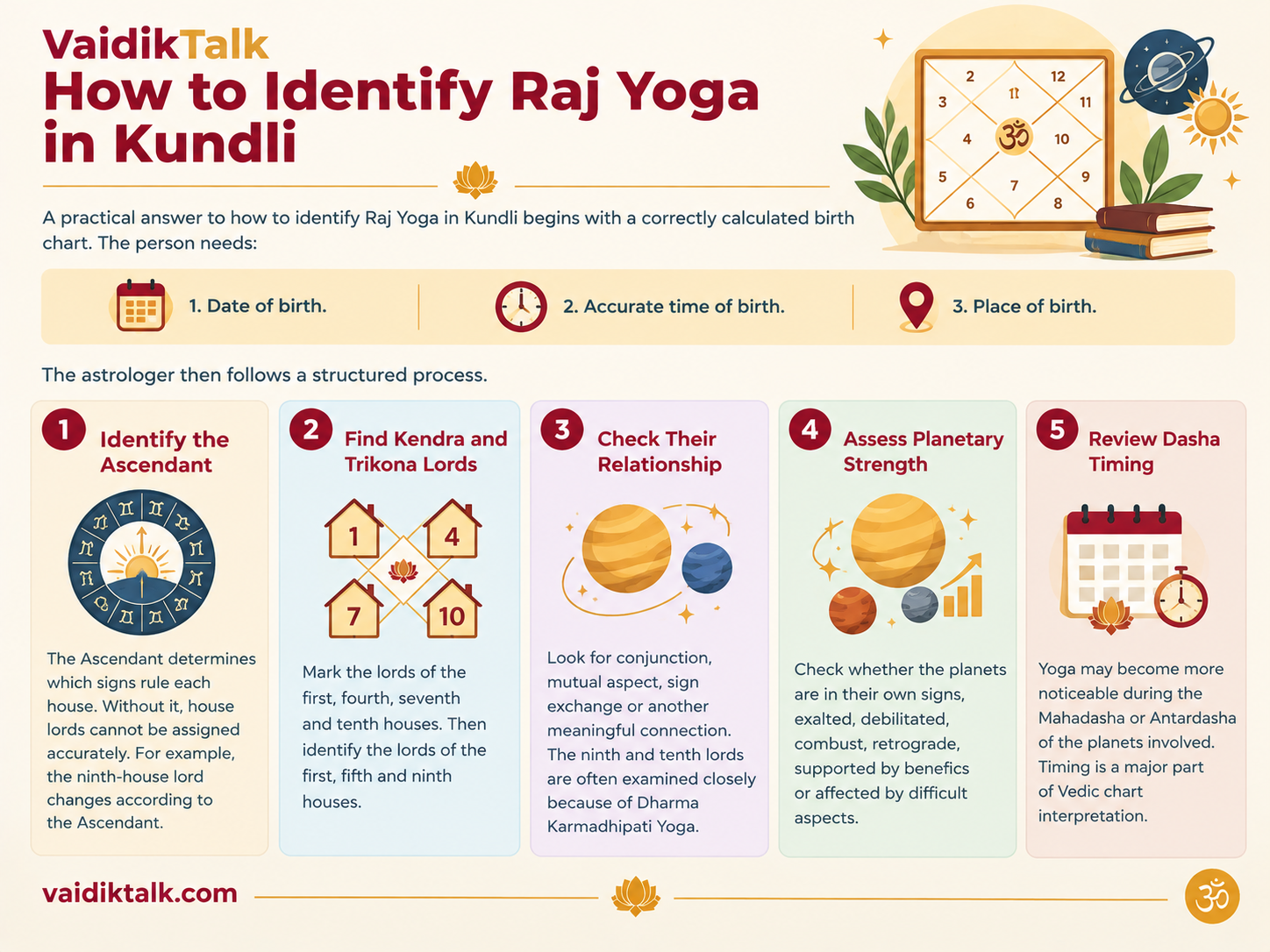
Check Their Relationship
Look for conjunction, mutual aspect, sign exchange or another meaningful connection. The ninth and tenth lords are often examined closely because of Dharma Karmadhipati Yoga.
Assess Planetary Strength
Check whether the planets are in their own signs, exalted, debilitated, combust, retrograde, supported by benefics or affected by difficult aspects.
Review Dasha Timing
Yoga may become more noticeable during the Mahadasha or Antardasha of the planets involved. Timing is a major part of Vedic chart interpretation.
Study Divisional Charts
The Navamsa can add detail about planetary strength and life development, while the Dashamsa is often studied for career-related themes. A professional astrologer may also analyse transits and other classical factors.
For marriage-related chart analysis, readers may compare online Kundli matching with traditional Guna Milan. Compatibility should be approached with communication, shared values and practical planning, not a score alone.
Raj Yoga and Career Significance
Raj Yoga is often associated with recognition, leadership and growth because it links houses related to action, purpose and status. In a modern setting, this may appear as:
- Advancement in a career.
- Ability to take responsibility.
- Respect within a community.
- Success in teaching, management, entrepreneurship or public service.
- Strong motivation to build a reputation through work.
However, a Raj Yoga does not remove the need for study, effort or ethical conduct. A person can use a favourable interpretation as encouragement to prepare well, develop skills and pursue opportunities responsibly.
The International Labour Organization estimated that global unemployment was 4.9% in 2024, representing about 183 million people. Career outcomes are shaped by economic conditions, education, access and labour markets, alongside individual effort.
Raj Yoga and Other Chart Conditions
Raj Yoga can coexist with other combinations. Astrologers may assess whether it is supported, delayed or modified by different planetary conditions. It is inaccurate to conclude that one yoga cancels every other chart factor.
For example, Sade Sati and its traditional signs are often assessed using Saturn’s transit in relation to the Moon sign. Likewise, the difference between Kaal Sarp Dosh and Sade Sati shows why separate astrological concepts need separate methods of analysis.
For relationship topics, Manglik Dosh describes how astrologers examine Mars-related placements. These ideas should be interpreted thoughtfully, without fear or pressure.
Remedies and Responsible Practice
Traditional remedies may include mantra recitation, prayer, charitable acts, fasting practices, temple visits, service and the use of devotional items. A remedy should be chosen respectfully and voluntarily, based on a person’s beliefs and budget.
Some people wear Rudraksha as part of their spiritual practice. Readers can learn about Rudraksha origin and traditional significance, as well as Rudraksha benefits. Buyers may also read what certification means when purchasing Rudraksha online before selecting any product.
Gemstone recommendations require care because gem quality, treatment, authenticity and suitability vary. Before buying, readers can compare emerald and peridot and browse spiritual products at Vaidik Talk Store. A gemstone or spiritual object should not be treated as a substitute for medical, legal, financial or mental-health guidance.
Raj Yoga and Other Spiritual Systems
Jyotish is one of several systems people use for reflection. Readers can learn how Nadi astrology differs from Vedic astrology to understand differences in method and emphasis.
Those interested in numbers may read about numerology or explore what a life path number is traditionally understood to mean. These systems use different frameworks and should not be mixed without understanding their distinct principles.
Speak With an Astrologer
Raj Yoga in Kundli refers to favourable planetary combinations traditionally associated with leadership, recognition, opportunity and accomplishment. Its formation often involves Kendra and Trikona house lords, but its result depends on planetary strength, timing, houses, aspects and the full chart.
For a personal Kundli reading or help with how to identify Raj Yoga in Kundli, readers can contact Vaidik Talk. VaidikTalk offers access to practitioners in Vedic astrology, Kundli analysis, numerology, Vastu and related spiritual guidance.
Frequently Asked Questions (FAQs)
What is Raj Yoga in Kundli?
Raj Yoga is a traditional Vedic astrology term for favourable planetary combinations linked with status, progress, recognition and authority.
How is Raj Yoga formed?
It is commonly formed when the lords of Kendra and Trikona houses connect through conjunction, aspect or sign exchange.
Does Raj Yoga guarantee wealth or success?
No, Raj Yoga is a faith-based interpretation and cannot guarantee financial, career or life outcomes.
Which houses are important for Raj Yoga?
The first, fourth, seventh and tenth houses are Kendras, while the first, fifth and ninth houses are Trikonas.
Can Raj Yoga give results later in life?
Traditional astrology often links results to the relevant planetary dasha, chart strength and life circumstances.