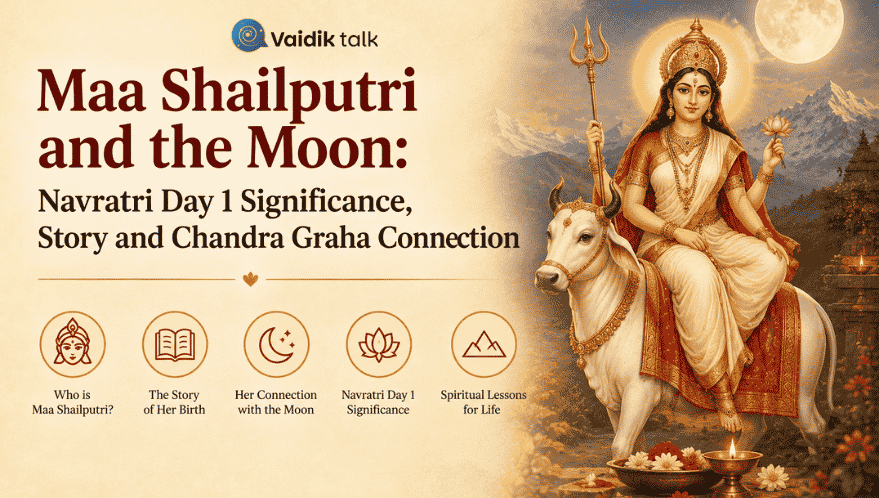
Maa Shailputri is the first of the nine forms of Durga, worshipped on Pratipada, the opening day of Navratri, which in 2026 fell on Sunday, October 11. This guide covers who Maa Shailputri is, the story behind her, the Maa Shailputri mantra, the Navratri Day 1 puja vidhi, and the popular link between her and the Moon. Readers newer to the planetary side of this link may find Vaidik Talk's guide on what is Vedic astrology a useful starting point.
Who Is Maa Shailputri? The Meaning of the Name
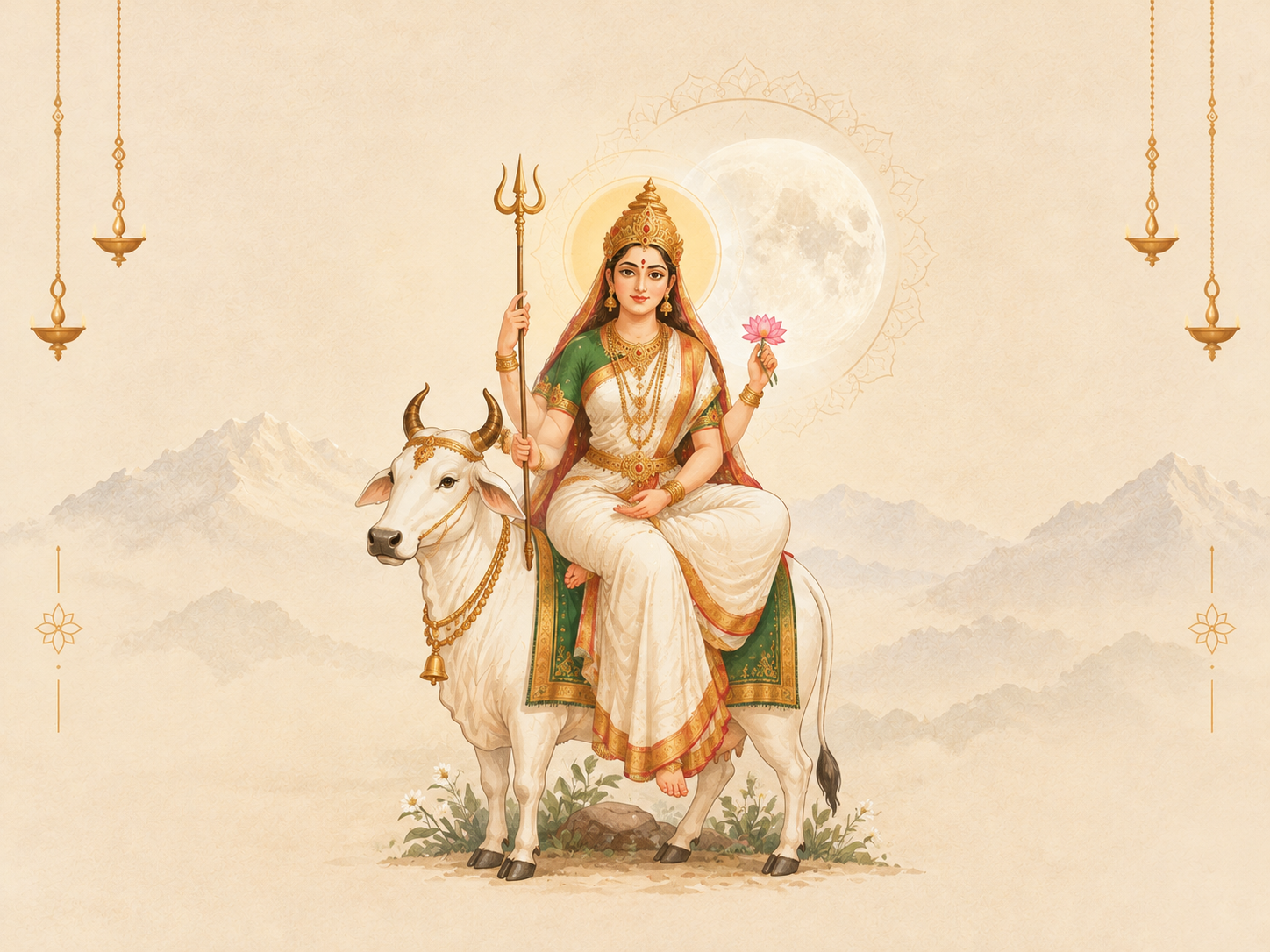
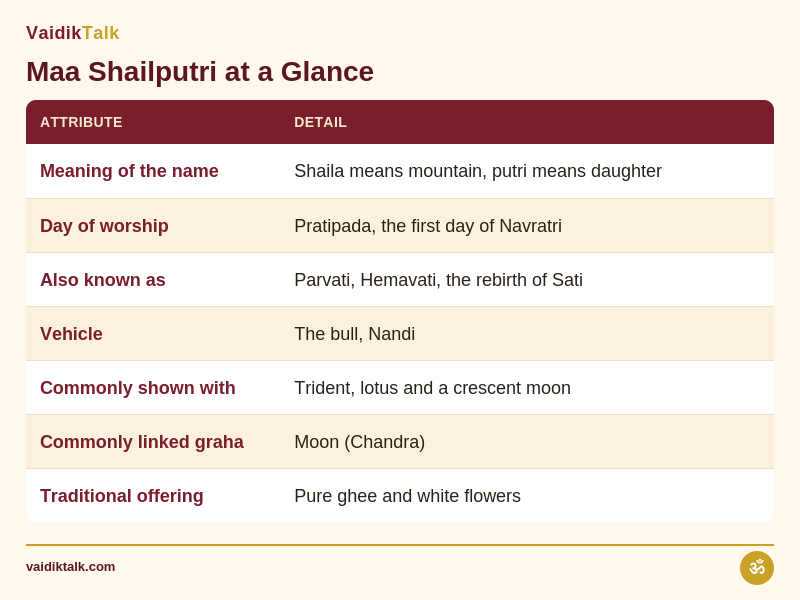
The name joins two Sanskrit words: shaila, meaning mountain, and putri, meaning daughter. She is the daughter of the mountain, and in the traditional account she is Parvati, born to Himavat, the lord of the Himalayas. Britannica's entry on Parvati describes her as the daughter of the mountain called Himalaya, who won Shiva's affection only after severe ascetic discipline. Maa Shailputri is commonly shown seated on a bull with a trident in one hand and a lotus in the other, and a crescent moon on her forehead
The Story of Maa Shailputri: From Sati to Parvati
The story begins with Sati, the daughter of Daksha and the first wife of Shiva. When Daksha held a great sacrifice and did not invite Shiva, Sati attended anyway, was shamed by her father's words, and gave up her life. In the traditional account she was reborn as the daughter of Himavat, and that rebirth is Shailputri. Accounts differ in detail between the Puranas, but the common thread is a return, a second beginning, and a devotion that continues across lifetimes.
This is one reason she opens the festival: the first night belongs to starting again with steadiness.
Maa Shailputri and the Moon: The Chandra Graha Connection
Among the popular pairings of the nine forms with the nine grahas, the link between Maa Shailputri and the Moon is the most widely repeated. It also has a textual hook: the traditional meditation verse describes her as crowned with a half moon. The pairings for other days vary between sources, so they are best read as a symbolic lens, not a rule written in scripture.
In Vedic astrology the Moon stands for the mind and emotional life, and the Moon sign in a birth chart is the anchor for several readings. The seven and a half year Saturn transit explained in Vaidik Talk's guide on what is Sade Sati is counted from the natal Moon. There is an astronomical thread too. NASA's Goddard eclipse resource gives the Moon's sidereal month as 27.32 days, and Britannica's entry on nakshatras notes that the Hindu system divides the sky into 27 or 28 lunar mansions, which is why the Moon's position drives the nakshatra in a birth chart.
The Moon appears in numerology as well. In the Vedic mapping covered in Vaidik Talk's guide on what is numerology, the number 2 is linked with the Moon, and the Life Path 2 profile in the guide on the Life Path Number calculator centers on cooperation and sensitivity, themes that sit comfortably beside the Moon's reputation for mind and mood.
Maa Shailputri at a Glance
Navratri Day 1 Puja Vidhi
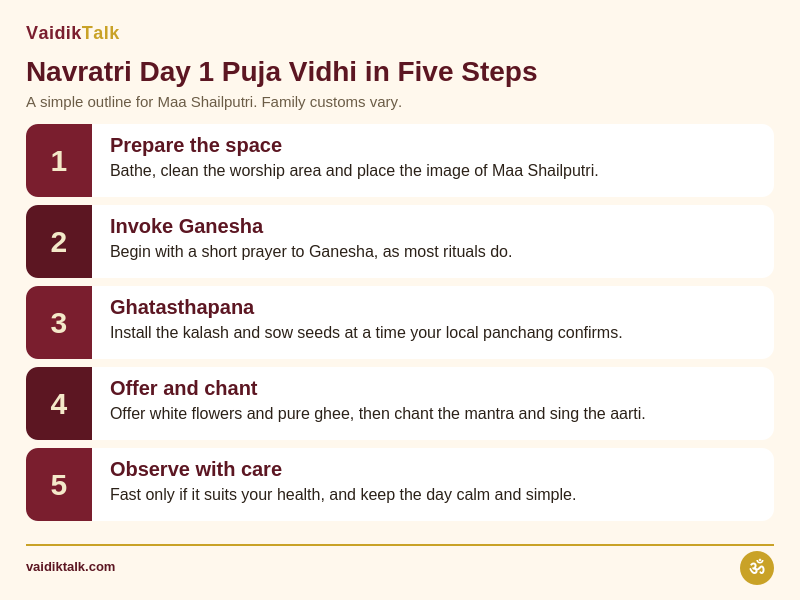
The Navratri Day 1 puja vidhi usually begins with a bath, a clean worship space and a prayer to Ganesha. Next comes Ghatasthapana, the installation of a kalash with water, mango leaves and a coconut, often alongside a pot in which grain seeds are sown. After that, Maa Shailputri is worshipped with white flowers and pure ghee, followed by the mantra and an aarti. Many families also light a lamp that stays lit through the nine nights.
Timing deserves care this year. One news report from Nepal, citing the Nepal Panchanga Development Committee, said the first day carried Chitra Nakshatra and Vaidhriti Yoga, which is why advice on the Ghatasthapana window differs between sources. Since muhurat times also shift from city to city, a local priest or panchang is the safest guide, and family custom can vary.
Maa Shailputri Mantra
The short Maa Shailputri mantra most devotees chant is: Om Devi Shailaputryai Namah
It is a salutation to Goddess Shailaputri and is commonly repeated 108 times on a mala. The traditional meditation verse reads:
Vande Vanchhitalabhaya Chandrardhakritashekharam, Vrisharudham Shuladharam Shailaputrim Yashasvinim
In simple terms it says: I bow to Shailaputri, who grants desired boons, whose crown carries a half moon, who rides a bull, holds a trident and is glorious. Readers who chant on a mala can look at Vaidik Talk's Rudraksha collection. Pronunciation matters in chanting, so learning the verse from a priest or a trusted recording is worthwhile.
Observances, Offerings and Gentle Cautions
Pure ghee is the offering most often named for Maa Shailputri, and some devotees observe a fast on the first day. Fasting is a personal choice, and anyone with a medical condition should adapt it on a doctor's advice. Offerings and fasts are devotional practices. They are not a substitute for chart based advice, and they do not repair a difficult placement of the Moon in a kundli.
Getting Started
Anyone who wants to know their own Moon sign and nakshatra can generate a chart with Vaidik Talk's Kundli Generation tool. Planet linked gemstones are a separate decision made from a full chart, as explained in the guide on the best gemstone for career growth, and personal questions can be taken to a live astrologer by following the steps in the guide on how to talk to an astrologer online.
Getting the Right Guidance
Maa Shailputri's place at the start of Navratri is a reminder that every practice begins with a steady first step. Anyone with questions about the Moon in their own chart can reach out through the Contact Us page, and the team will point them to the right guidance.
Frequently Asked Questions
Who is Maa Shailputri?
She is the first form of Durga, worshipped on Day 1, born as the daughter of Himavat and understood as the rebirth of Sati.
What is the Maa Shailputri mantra?
The common mantra is Om Devi Shailaputryai Namah, usually chanted 108 times.
What does the Navratri Day 1 puja vidhi include?
It usually includes Ghatasthapana, worship with white flowers and pure ghee, the mantra and an aarti.
Why is Maa Shailputri linked with the Moon?
Her meditation verse describes a half moon on her crown, and the pairing with Chandra is the most widely repeated, though it is a popular reading, not scripture.