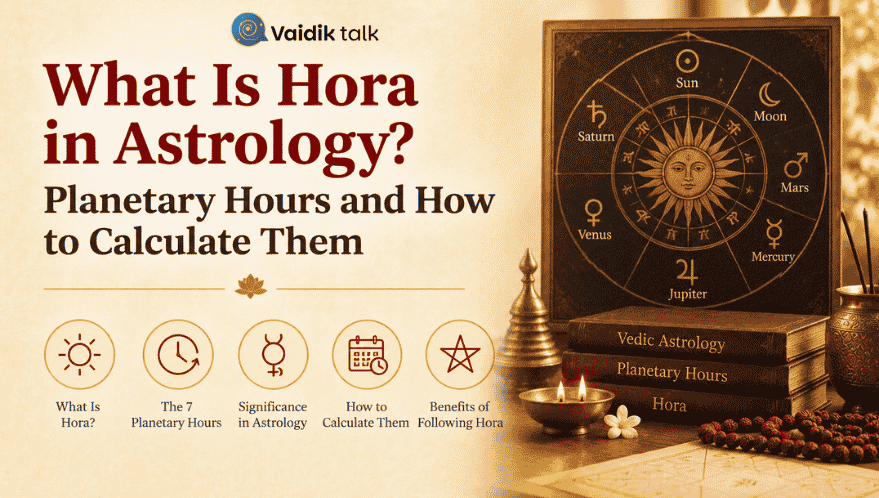
Hora in astrology is a traditional system for dividing a full day and night into 24 planetary time periods. Each period, called a Hora, is ruled by one of the seven classical planets: Sun, Moon, Mars, Mercury, Jupiter, Venus and Saturn. The method begins at local sunrise, not at midnight.
A complete sunrise-to-sunrise cycle contains 24 Horas: 12 during daylight and 12 during the night. Daytime Horas are calculated from sunrise to sunset, while nighttime Horas are calculated from sunset to the following sunrise. Their length changes by location and season, so a Hora is not fixed at 60 minutes.
For readers who are new to chart reading, we have a guide that explains what a Kundli is and how a birth chart is understood. Hora is one part of traditional Jyotish timing and is usually considered alongside Panchang, transits, Muhurat and the individual Kundli.
Meaning of Hora in Astrology
The word Hora is often linked with the idea of an hour, though a planetary Hora is based on the changing duration of daylight and night. In traditional practice, each Hora carries the symbolic qualities of its ruling planet.
For example, Jupiter Hora is traditionally associated with study, guidance, spiritual activities and advice. Venus Hora may be chosen for artistic work, relationships or comfort-related tasks. Saturn Hora may be used for disciplined work, responsibility and long-term planning.
A Hora chart in Vedic astrology is usually used for time selection rather than for predicting every event. People may consult it before meetings, travel, purchases, worship, study, business discussions or other important activities. Such interpretations reflect spiritual belief and should complement practical planning, rather than replace professional, medical, legal or financial advice.
The Seven Hora Planets
Only the seven visible classical planets are used in the Hora sequence. Rahu and Ketu are important in Vedic astrology but do not rule the standard planetary Hora cycle.
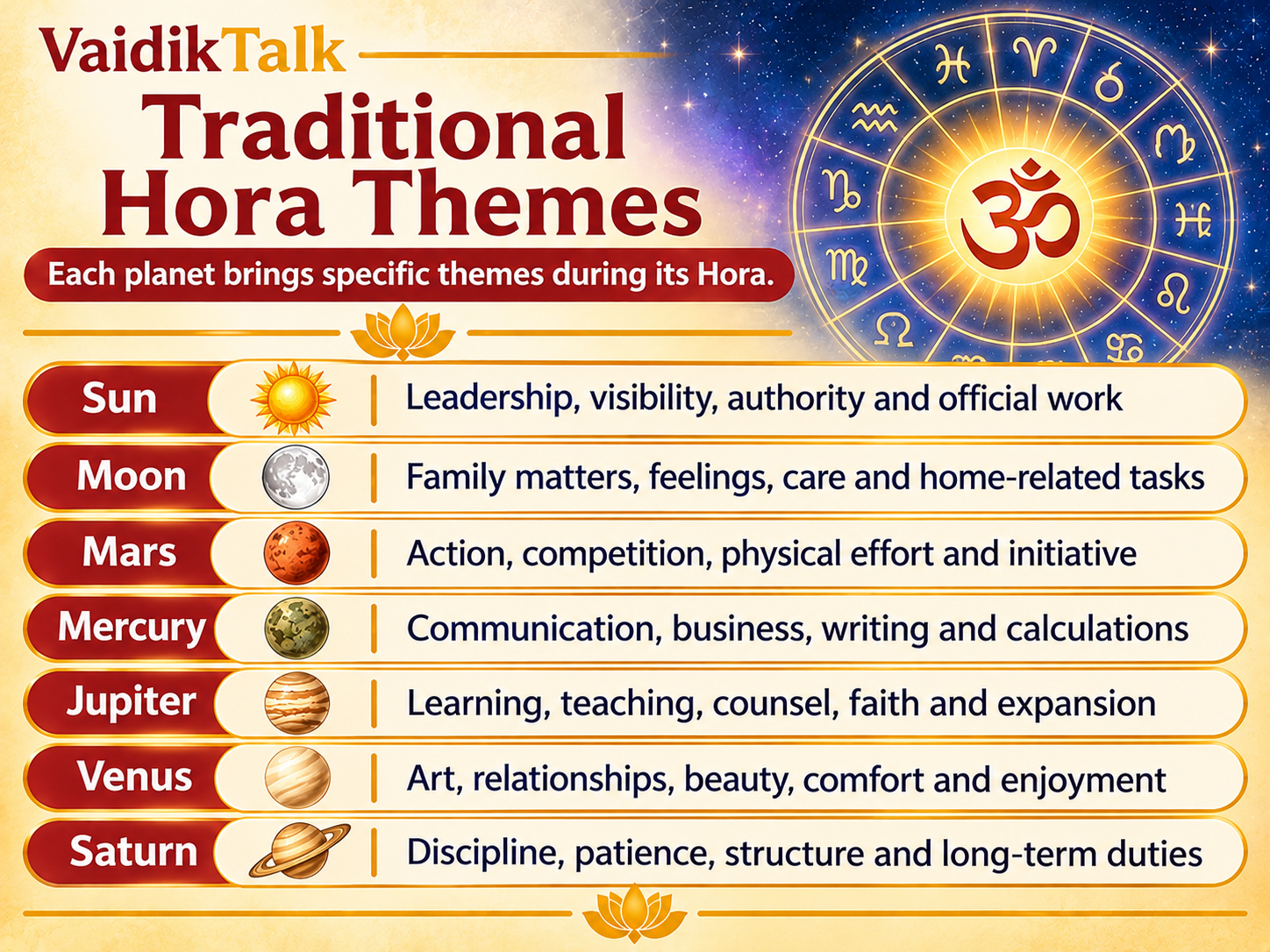
A Hora calculation reference describes the repeated planetary order as Sun, Venus, Mercury, Moon, Saturn, Jupiter and Mars. This sequence continues through the day and night without interruption.
Why Planetary Hours Change Daily
A common misunderstanding is that each Hora runs for exactly 60 minutes. That is only approximately true around the equinoxes, when day and night are near equal length.
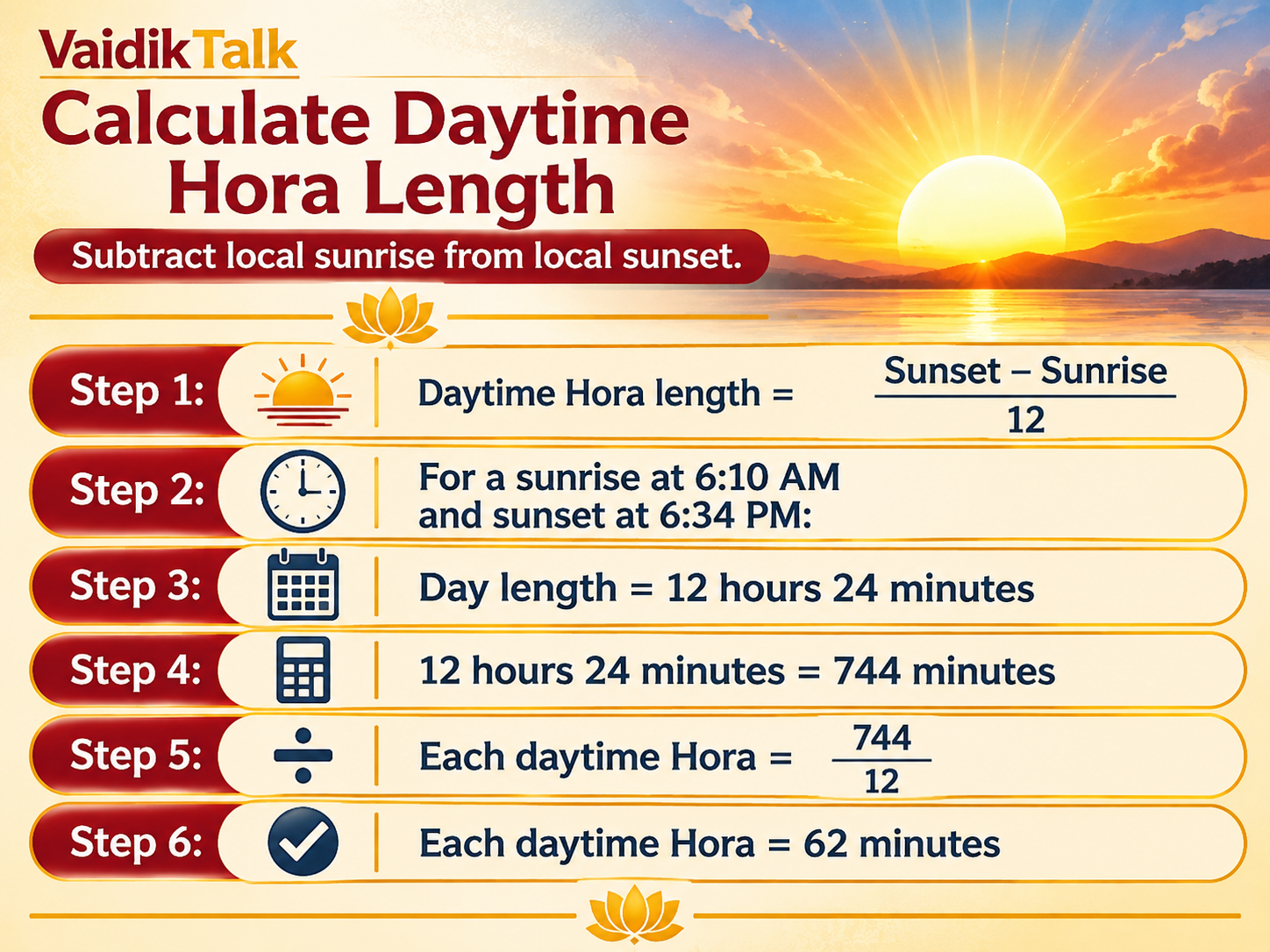
The daytime period from sunrise to sunset is divided into 12 equal parts. The nighttime period from sunset to the next sunrise is also divided into 12 equal parts. During longer summer days, daytime Horas last longer than 60 minutes, while nighttime Horas become shorter. During winter, the pattern reverses.
This is why a planetary hora calculator needs the city, date, local sunrise and local sunset time. The Indian Meteorological Department provides astronomical and weather-related information for India, including location-sensitive daily timing references.
The Planetary Hora Sequence
The Hora sequence follows the Chaldean order used in traditional astrology. It starts from Sun then Venus to Mercury followed by Moon, Saturn, Jupiter and Mars. After Mars, the sequence returns to the Sun. The order repeats every seven Horas.
The first Hora after sunrise is ruled by the planet that governs the weekday: Sunday belongs to the Sun, Monday aligns with Moon, Tuesday is parallel to Mars, Wednesday and Thursday have Mercury and Jupiter separately and lastly Friday and Saturday aligns with Venus and Saturn respectively.
For instance, Sunday begins with Sun Hora at local sunrise. The next Hora is Venus, followed by Mercury, Moon, Saturn, Jupiter and Mars. The eighth Hora returns to the Sun.
The weekly naming pattern follows this sequence because 24 Horas divided by a seven-planet cycle produces a shift of three planetary positions each new day.
How to Calculate Hora Step by Step
Find Local Sunrise and Sunset
The calculation begins with accurate local sunrise and sunset for the chosen location and date. Sunrise in Delhi differs from sunrise in Mumbai, Chennai or Kolkata, so copying a Hora table from another city may produce an incorrect result.
A planetary hora calculator uses location data because local latitude, longitude and seasonal daylight length affect Hora duration.
Calculate Daytime Hora Length
Calculate Nighttime Hora Length
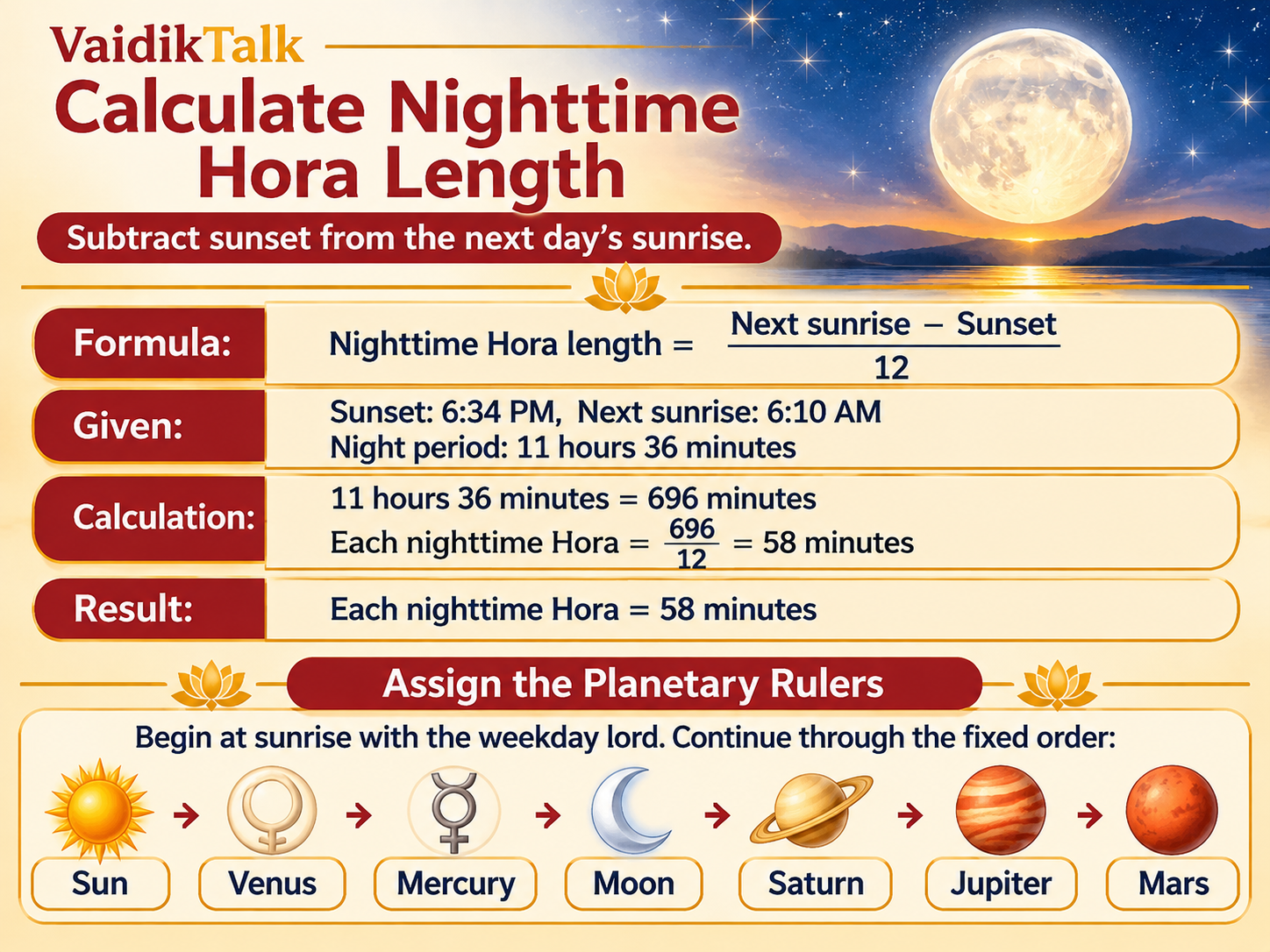
Repeat the sequence until all 24 Horas are assigned. A standard Hora framework confirms 12 daylight and 12 nighttime divisions, with the weekday lord ruling the first Hora after sunrise.
Example: Thursday Hora Calculation
Thursday is ruled by Jupiter. Therefore, the first Hora after local sunrise on Thursday is Jupiter Hora. The sequence then continues: From Jupiter to Mars to Sun to Venus to Mercury to Moon to Saturn to Jupiter to Mars to Sun to Venus to Mercury. The nighttime sequence continues from the next planet after the final daytime Hora. It does not reset at sunset.
In a Hora chart in Vedic astrology, Thursday’s Jupiter Hora is traditionally selected for study, teaching, spiritual reflection, meeting a mentor or beginning an education-related task. Such timing is a matter of personal belief and should be used with common sense and real-world preparation.
Traditional Use of Each Hora
Sun Hora
Sun Hora is traditionally associated with leadership, government work, official requests, visibility and self-confidence. People may choose this period for applications, authority-related communication or professional presentations.
Moon Hora
Moon Hora is connected with emotional matters, family discussions, hospitality, home concerns and activities involving care. It may be selected for speaking with relatives or organising domestic tasks.
Mars Hora
Mars Hora is associated with courage, physical effort, competition and decisive action. It may suit sports, repairs, technical tasks or focused effort. It may be avoided for sensitive conversations if a person wishes to reduce the chance of impatience.
Mercury Hora
Mercury Hora is traditionally linked with communication, writing, accounts, trade, study and paperwork. It may be preferred for emails, negotiations, learning and business planning.
Jupiter Hora
Jupiter Hora is associated with knowledge, teaching, religious practice, charity and wise counsel. It may be used for starting a course, consulting a teacher or planning long-term goals.
Venus Hora
Venus Hora is connected with beauty, relationships, music, art, comfort and social interaction. It may be selected for creative tasks, relationship discussions or aesthetic purchases.
Saturn Hora
Saturn Hora is associated with patience, work, discipline, structure and responsibilities. It may support tasks that need focus, persistence and careful organisation.
Hora and Muhurat
Hora is a short timing tool, while Muhurat is a broader method of selecting favourable time. A full Muhurat analysis may consider Tithi, Vaar, Nakshatra, Yoga, Karana, Rahu Kaal, planetary transits and the person’s birth chart.
For this reason, Hora alone is generally not used for major events such as marriage, property registration or a major business launch. It can provide one layer of timing, while a fuller Panchang and Kundli analysis gives more context.
Readers interested in marriage-related astrology can review Kundli matching online versus traditional Guna Milan and the traditional role of Manglik Dosh in marriage.
Hora and Birth Charts
The phrase Hora chart in Vedic astrology can also refer to the Hora divisional chart, known as D2. This is different from the daily planetary-hour system.
The D2 Hora chart is traditionally used to examine themes related to wealth, financial resources, sustenance and material capacity. It divides signs into solar and lunar sections according to classical Vedic methods. This chart should be interpreted with the main Kundli, house lords, Dashamsa, Navamsa and dasha periods.
A daily Hora table, by contrast, identifies which planet rules a particular time of day. Both use the word Hora but serve different purposes.
Readers may explore traditional Gajakesari Yoga themes and Neech Bhang Raj Yoga formation rules to understand why a complete chart reading studies multiple combinations.
Hora, Doshas and Wider Astrology
Hora is a timing method, while doshas and yogas are chart-based assessments. For example, Kaal Sarp Dosh and its traditional remedies involve a different chart pattern. Likewise, Sade Sati signs relate to Saturn’s transit from the Moon sign.
People interested in comparing systems can read Nadi astrology versus Vedic astrology. For number-based reflection, this introduction to numerology and this life path number guide offer related resources.
Spiritual Practices and Hora
Some people use a selected Hora for prayer, mantra practice, meditation or charity. A person may choose Jupiter Hora for spiritual study, Moon Hora for family prayer or Venus Hora for devotional music.
Rudraksha beads are also used by some people during mantra recitation. Readers can learn about Rudraksha origin and spiritual significance, as well as traditional and buyer-reported Rudraksha benefits.
Before buying prayer beads, review what Rudraksha certification means. Vaidik Talk Store offers Rudraksha and spiritual products for those who wish to include them in a personal practice.
For gemstone research, readers can compare emerald and peridot before making a purchase. Such products are faith-based items and do not replace professional healthcare, financial planning or legal services.
Consult an Astrology Expert
Hora in astrology divides the period from one sunrise to the next into 24 planetary intervals. A person can calculate each Hora by dividing the daylight period into 12 parts and the nighttime period into 12 parts, then applying the repeating seven-planet sequence.
A planetary hora calculator can simplify the timing process, though accurate city-based sunrise and sunset data remain important. For guidance on a Hora chart in Vedic astrology, Kundli interpretation, Panchang timing or a personal Muhurat, readers can contact Vaidik Talk. VaidikTalk offers astrology consultations, Kundli reports, relationship guidance and spiritual services.
Frequently Asked Questions (FAQs)
What is Hora in astrology?
Hora in astrology is a traditional planetary-hour system that divides one sunrise-to-sunrise cycle into 24 planetary periods.
How many Horas are there in a day?
There are 24 Horas, with 12 calculated from sunrise to sunset and 12 from sunset to the next sunrise.
Does every Hora last 60 minutes?
No, Hora duration changes with the length of day and night at a specific location and date.
Which planet rules the first Hora of the day?
The weekday lord rules the first Hora after sunrise, such as Sun on Sunday and Jupiter on Thursday.
What does a planetary hora calculator need?
A planetary hora calculator needs the date, location, local sunrise, local sunset and the following day’s sunrise.