
Saturn return vs Sade Sati is a comparison between two different astrological timing methods. Both involve Saturn, but they use different birth-chart reference points. A Saturn return relates to natal Saturn, while Sade Sati relates to the natal Moon.
Confusing them can lead to inaccurate dates and unnecessary anxiety. Neither condition establishes that a person will experience unemployment, separation, illness or financial loss.
Saturn completes an orbit around the Sun in approximately 29.4 Earth years, according to NASA’s Saturn facts. This slow movement provides the astronomical background for both timing frameworks, although their personal meanings belong to astrology.
Readers unfamiliar with birth-chart terminology can begin with what a Kundli contains and the foundations of Vedic astrology.
Understanding the Two Frameworks
What Is a Saturn Return?
In Saturn return astrology, transiting Saturn reaches its natal zodiacal longitude, typically around ages 29–30, 58–60 and 88–90. The exact date requires an individual calculation rather than an age-based assumption.
Astrodienst’s Saturn return reference distinguishes the exact return from broader surrounding interpretations.
Astrologers commonly associate the first return with adulthood, accountability and long-term commitments. Later returns may be interpreted through changing responsibilities, retirement decisions or reassessment of priorities. These are symbolic themes, not events that everyone experiences.
The return is especially prominent in modern Western astrology, although planetary returns can also be considered within other traditions.
What Is Sade Sati?
The basic Shani Sade Sati meaning is Saturn’s passage through three consecutive sidereal signs: the sign before the natal Moon, the Moon sign itself and the following sign.
Its name refers to approximately seven and a half years. The three phases are conventionally described as lasting around two and a half years each, although actual durations vary.
VaidikTalk’s guide to Sade Sati introduces this Moon-based framework. Emotional concerns, family duties and financial responsibilities are common traditional themes, but they should not be presented as inevitable difficulties.
Sade Sati is a transit condition, not a permanent defect in a birth chart.
Differences and Timing
The Main Distinctions
The clearest way to understand Saturn return vs Sade Sati is to identify what Saturn is being compared with.
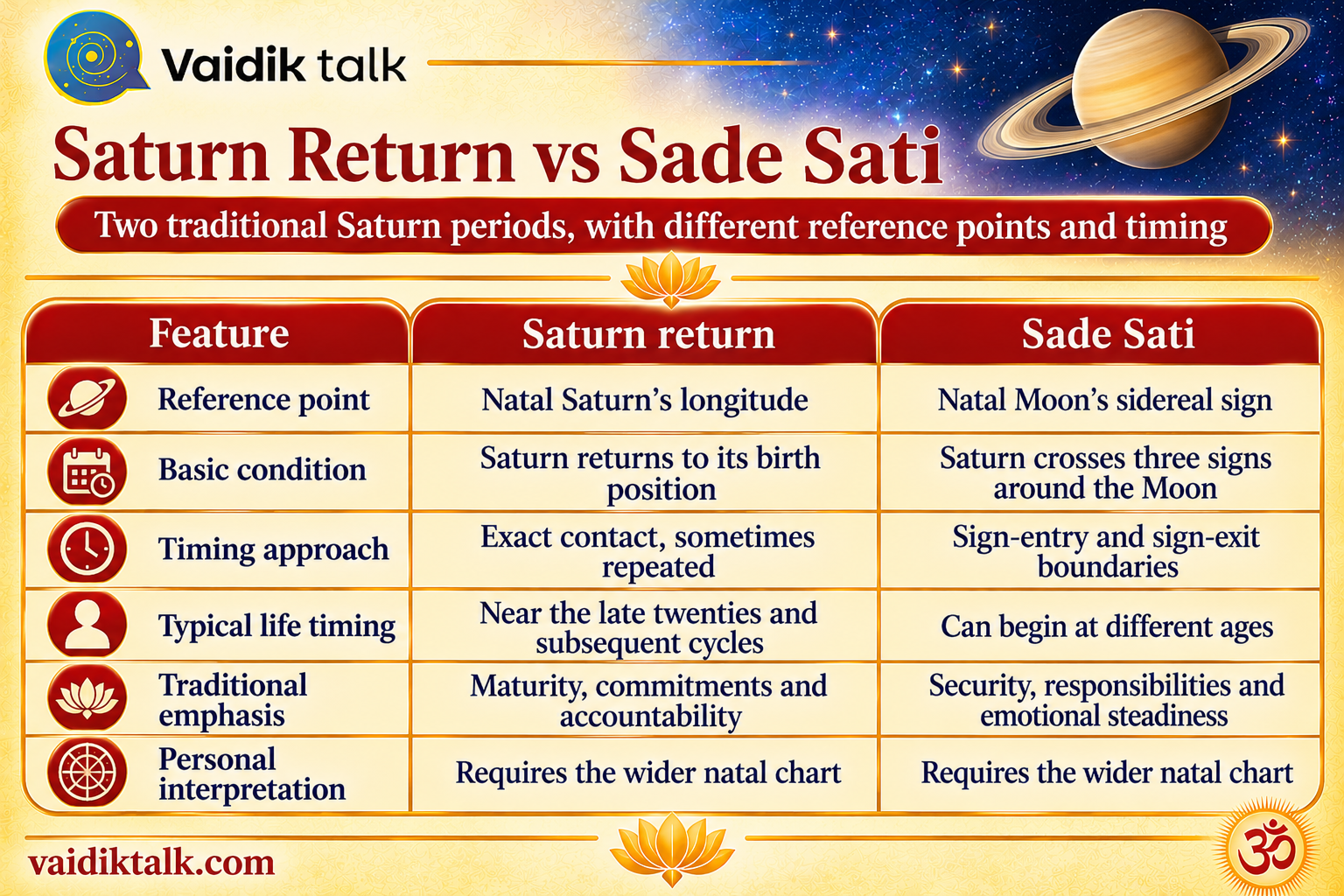
Neither framework can be identified reliably from someone’s Sun sign alone. Birth details and consistent calculation settings matter more than a generic age or horoscope label.
Exact Contacts Versus Broad Windows
A Saturn return is exact when Saturn reaches the relevant natal longitude. Astrologers may discuss a wider interpretive window, but there is no single universally accepted window length.
Apparent retrograde motion can create repeated contacts with the same degree. Retrograde is a viewing effect, not a physical reversal of Saturn’s orbit, as explained in Britannica’s retrograde-motion reference.
Sade Sati instead uses sign boundaries. Retrograde crossings can therefore produce exits and re-entries near those boundaries, making the familiar seven-and-a-half-year figure approximate rather than exact.
A useful calculation should list the relevant dates rather than simply assigning a difficult period to an entire decade.
Why Zodiac Settings Matter
The zodiac is conventionally divided into 12 signs of 30 degrees, as described in Britannica’s zodiac overview.
Western Saturn-return readings often use the tropical zodiac, while Vedic Sade Sati calculations generally use a sidereal zodiac. Their reference systems should remain explicit.
For sidereal calculations, the selected ayanamsa also matters. Mixing tropical placements, sidereal signs and unspecified calendar settings can produce inconsistent results.
Overlap and Astrological Meaning
Can Both Happen Together?
Yes, a Saturn return and Sade Sati can overlap, but one does not automatically imply the other.
For example, a chart with natal Saturn and the Moon in the same sidereal sign can have its Saturn return during the middle Sade Sati phase. However, sharing a sign does not mean Saturn is simultaneously making an exact conjunction with both bodies.
If natal Saturn is elsewhere, the return may occur outside Sade Sati. This distinction explains why two people of similar age can receive different transit assessments.
An overlap does not prove that outcomes will be more severe. It identifies two interpretive conditions, not a measurable multiplication of risk.
Themes Without Fixed Predictions
Saturn return astrology commonly frames this period around questions of responsibility, boundaries and lasting commitments. Sade Sati interpretations often focus more directly on security, emotional resilience and practical duties.
A constructive reading separates these themes from claims about specific events. Career dissatisfaction, for instance, requires examination of workload, pay, management and available alternatives.
Likewise, relationship difficulties call for communication and attention to safety. Kundli matching and Guna Milan and Bhakoot Dosha interpretations are separate traditional frameworks, not substitutes for consent or mutual respect.

The Shani Sade Sati meaning is therefore better presented as a symbolic context than a diagnosis of someone’s circumstances.
Other Chart Conditions Remain Separate
Neither transit independently establishes Kaal Sarp Dosh or Manglik Dosh. The Kaal Sarp Dosh versus Sade Sati comparison explains their different traditional bases.
Similarly, Gajakesari Yoga, Neech Bhang Raj Yoga and other Raj Yogas require their own chart assessment.
An astrologer may consider several factors together, but adding labels does not establish the accuracy of a prediction.
Responsible Interpretation and Consultation
Evidence and Practical Decisions
Britannica classifies astrology as divination. Personal interpretations should remain distinct from established medical, legal and financial assessments.
Fatigue, distress or persistent anxiety should not be diagnosed as Saturn-related. Appropriate professional support remains important regardless of a transit calendar.
Practical responses to uncertainty include reviewing expenses, clarifying responsibilities, documenting agreements and protecting time for rest. These actions can be useful without accepting an astrological explanation.
Different interpretive methods also need clear boundaries. Nadi and Vedic astrology, numerology and life path calculations are not interchangeable assessments.
Likewise, planetary hours or Hora concern a different timing practice.

Optional Spiritual Practices
People observing either period may find personal meaning in prayer, modest charity or regular reflection. Such observances should remain voluntary and affordable.
Readers can explore traditional Lal Kitab upay, Rudraksha’s spiritual significance and traditional and buyer-reported benefits.
VaidikTalk Store lists a 5 Mukhi Rudraksha bracelet and a 5 Mukhi Rudraksha Kantha Mala. These are optional devotional accessories, not evidence of protection from adverse events.vaidiktalk+1
Gemstone purchases, including choices discussed in emerald versus peridot, require separate consideration. A transit label alone is insufficient reason for an expensive purchase.
Conclusion: Context Before Predictions
The central distinction in Saturn return vs Sade Sati is straightforward: one follows natal Saturn, while the other follows the natal Moon. Their timing may overlap, but their definitions remain separate.
A balanced understanding of Shani Sade Sati meaning and Saturn return astrology prioritises accurate calculations, clear limitations and freedom from fear-based claims.
Readers seeking individual context can compare Kundli-making services and contact Vaidik Talk to discuss birth details, calculation methods and consultation scope.
Frequently Asked Questions
Is a Saturn return the same as Sade Sati?
No, a Saturn return references natal Saturn, while Sade Sati references the natal Moon.
Does Sade Sati begin around age 29?
No, its starting age depends on the Moon’s natal sign and Saturn’s position.
Can both periods overlap?
Yes, their overlap depends on the relationship between natal Saturn and the Moon.
Does either period predict misfortune?
Neither framework establishes a specific negative outcome for an individual.
How can their reference points be distinguished?
The simple way to distinguish the reference points is to check which natal placement is being tracked, Saturn’s position or the Moon’s sign.