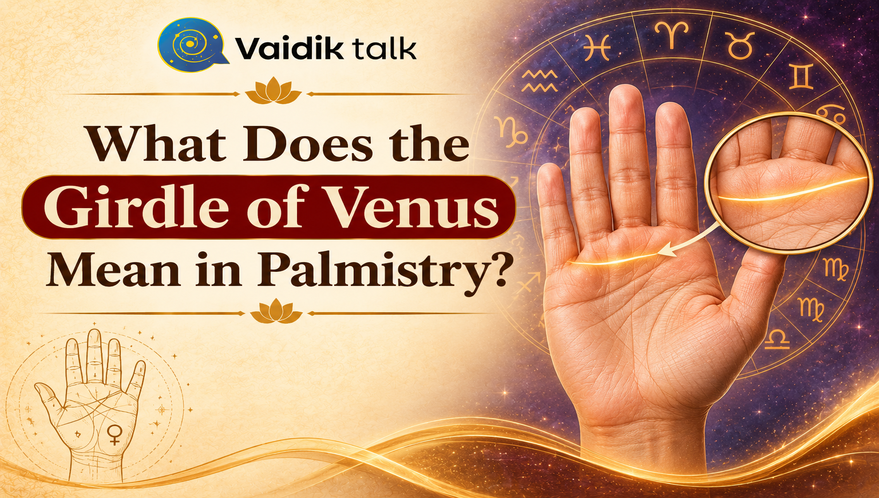
The Girdle of Venus in palmistry is a curved secondary line above the heart line. Traditional readers associate it with heightened sensitivity, appreciation of beauty and emotional intensity. It may appear as a continuous arc, several fragments or no recognisable marking at all.
These interpretations belong to a symbolic tradition. Britannica’s overview of palmistry explains that predictive claims based on hand features lack scientific support. A crease cannot establish someone’s romantic future, loyalty, sexuality or mental health.
Understanding the Girdle of Venus meaning therefore requires two separate considerations: identifying the marking correctly and recognising the limits of its interpretation. The popular phrase palmistry love line can create additional confusion because it often refers to the heart line rather than this smaller arc.
Location and Traditional Meaning
Where Is the Girdle of Venus?
The traditional marking curves beneath the middle and ring fingers, above the heart line. Its usual endpoints lie near the gaps between the index and middle fingers and between the ring and little fingers.
A reader typically looks for three identifying features:
- A position high on the palm, below the finger bases.
- A curved shape rather than a long horizontal crease.
- Separation from the main heart line.
An incomplete arc may consist of disconnected sections. Small intersecting creases, however, should not automatically be treated as a complete girdle.
The marking is also different from the Mount of Venus, the padded area near the thumb. Similar terminology does not make these features interchangeable.
Why Is Venus in Its Name?
Venus carries longstanding associations with love and beauty. Britannica’s account of the Roman goddess Venus provides cultural context for that symbolism.
Within palmistry, Venus-related language often connects physical markings with affection, aesthetic interests and sensual experience. Such associations are interpretive conventions, not evidence that the planet Venus produces a particular hand crease.
Likewise, palmistry should remain distinct from Vedic astrology. A palm feature and a Kundli or birth chart use different reference systems.
Sensitivity Without Stereotypes
The most common Girdle of Venus meaning concerns sensitivity. Some readers connect the marking with strong responses to atmosphere, affection, criticism or artistic expression.
These descriptions should not become labels such as unstable, unfaithful or emotionally weak. A person’s behaviour must be assessed through actual conduct and circumstances, not a hand marking.
Someone who identifies with the symbolism might reflect on boundaries or creative interests. That reflection remains useful only if it supports personal choice rather than fear.
Variations and the Love Line
Continuous and Broken Arcs
Traditional interpretations distinguish a clear arc from a fragmented one. These distinctions vary between readers and lack validated predictive value.
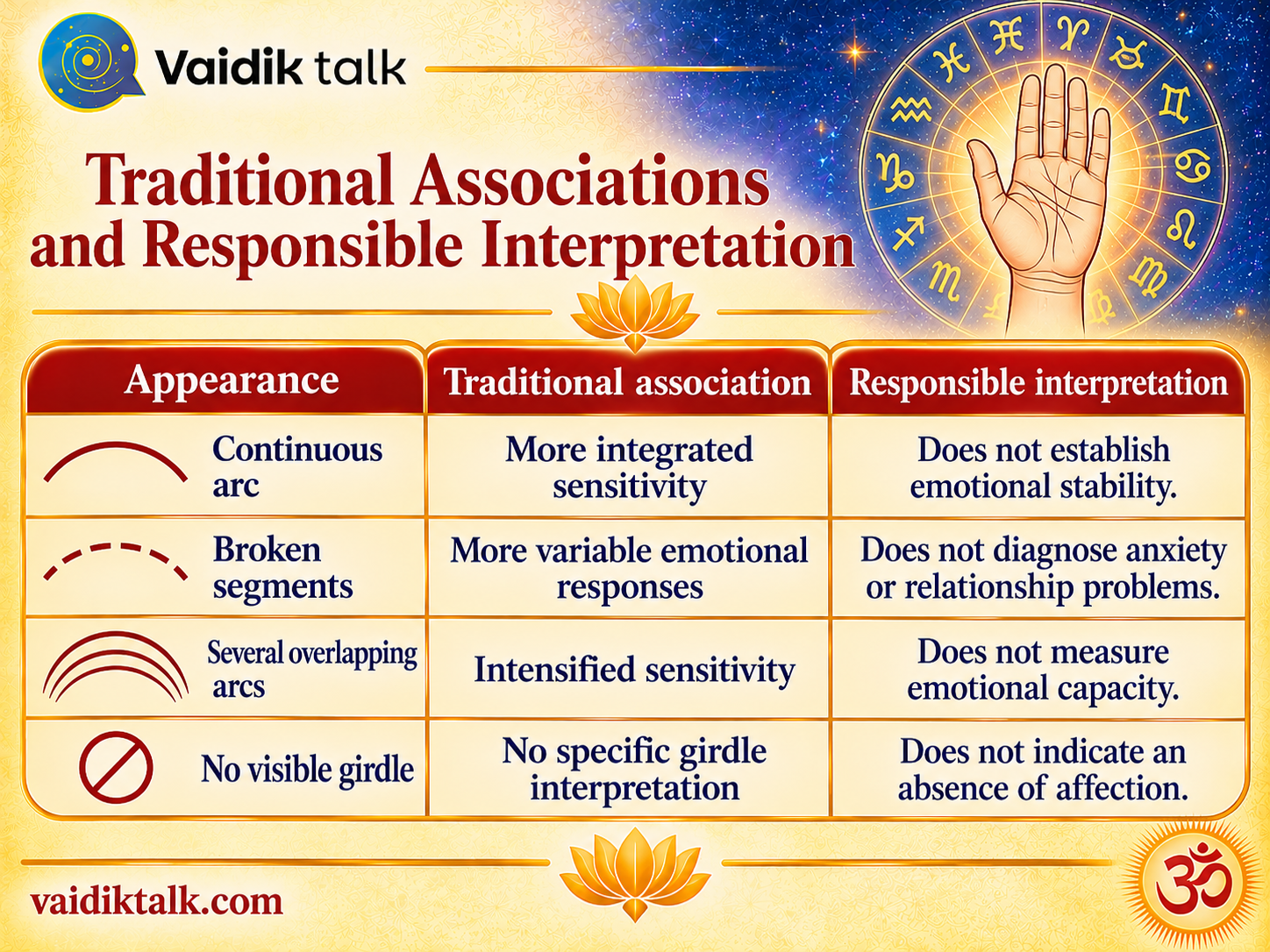
The symbolic associations above reflect palmistry conventions rather than medical or psychological assessment.
Lighting, hand position and image quality can also affect how clearly minor creases appear. A confident prediction based on a blurred photograph deserves particular caution.
Is It the Palmistry Love Line?
The term palmistry love line commonly refers to the heart line, the longer line running across the upper palm. The Girdle of Venus sits above it and is treated as a separate feature.
The distinction matters because a reader discussing the heart line may be examining a different crease altogether. Clear terminology is more useful than assigning several names to one unclear photograph.
Neither feature establishes whether a relationship will succeed. Traditional marriage frameworks, including Kundli matching and Guna Milan and Bhakoot Dosha interpretations, also require separation from evidence about relationship quality.
Does Either Hand Matter More?
Palmistry schools differ in how they interpret the dominant and non-dominant hands. That variation is one reason different readers can produce different accounts of the same person.
A responsible consultation should explain its method rather than presenting one convention as universal fact. Claims that a particular hand determines marriage outcomes for every man or woman deserve scrutiny.
The Girdle of Venus in palmistry should therefore be discussed within an identified tradition, with uncertainty made explicit.
Evidence, Relationships and Related Beliefs
What Do Palm Creases Establish?
Hand creases are physical features, while personality predictions are additional interpretations. The two should not be confused.
For anatomical context, MedlinePlus states that people most often have three palmar creases and that creases generally develop by approximately the 12th week of gestation. Its information on a single palmar crease also reports that this separate variation appears in about 1 in 30 people.
Those figures concern anatomy, not the prevalence of the Girdle of Venus. They do not justify claims that a particular percentage of people possess this palmistry marking.
No reliable prevalence figure is established by the sources cited here. Describing the girdle as exceptionally rare would therefore require better evidence.
Can It Predict Love?
A palmistry love line cannot establish compatibility, fidelity or the timing of marriage. Britannica identifies palmistry’s predictive claims as unsupported by scientific evidence.
A broken arc should not be used to accuse a partner of dishonesty. An absent marking should not be interpreted as an inability to love.
Observable behaviour offers a firmer basis for relationship decisions. The NHS recommends respect, listening and open conversation in its guidance on healthy relationships and mental wellbeing.
Persistent distress deserves appropriate support rather than a diagnosis drawn from a palm photograph.
Keep Different Systems Separate
A palm marking does not establish astrological conditions such as Kaal Sarp Dosh, Manglik Dosh or Sade Sati. The Kaal Sarp Dosh versus Sade Sati comparison discusses their different traditional bases.
Similarly, Gajakesari Yoga, Neech Bhang Raj Yoga and other Raj Yogas concern chart configurations, not palm creases.
Readers comparing traditions can explore Nadi versus Vedic astrology, numerology and life path calculations.
These methods should not be combined as though agreement between several symbolic readings proves a prediction.
Consultation, Accessories and Conclusion
What Makes a Responsible Reading?
A useful explanation of the Girdle of Venus meaning identifies the feature, names the interpretive tradition and acknowledges uncertainty.
Consultations deserve caution if they involve urgent threats, medical diagnoses, accusations about partners or expensive purchases presented as necessary protection. A hand marking does not justify those claims.
Birth-chart questions can be discussed separately through Kundli-making services. Likewise, planetary hours or Hora concern a different timing practice.
Are Remedies or Products Required?
A visible, broken or absent girdle does not establish a need for a remedy. Readers interested in spiritual customs can explore traditional Lal Kitab upay without treating general suggestions as personal prescriptions.
Optional accessories include VaidikTalk Store’s Rose Quartz Heart Shape Pendant and Love Attraction Gem Chips Bracelet. Their product names are not evidence that they attract a partner or change relationship outcomes.
Further reading includes Rudraksha’s spiritual significance, traditional and buyer-reported benefits and emerald versus peridot.
Conclusion: Symbolism Without Judgment
The Girdle of Venus in palmistry is traditionally associated with sensitivity and aesthetic appreciation. It is distinct from the heart line and cannot establish personality, health or romantic destiny.
Readers seeking a discussion of the marking can contact Vaidik Talk to ask about consultation methods, privacy and interpretive limitations.
Frequently Asked Questions
Where is the Girdle of Venus located?
It forms an arc above the heart line, beneath the middle and ring fingers.
What is its traditional meaning?
Palmists commonly associate it with heightened sensitivity and emotional intensity.
Is it the same as the love line?
No, the phrase palmistry love line usually refers to the separate heart line.
Does a broken girdle predict relationship failure?
No, palm markings cannot establish a relationship’s future.
How can symbolism be distinguished from prediction?
The key question is: what observable evidence supports the claim beyond the appearance of a palm crease.